$x^2+y^2$, quasiconcavity and upper level set
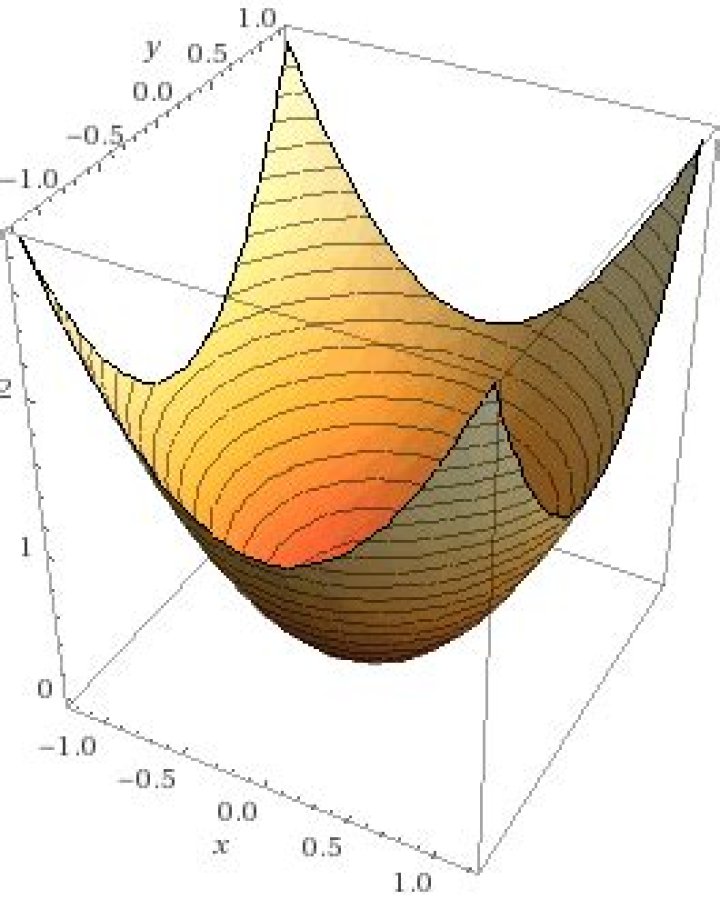
I am having some trouble wrapping my head around quasiconcavity. I have a couple of definitions:
- A function $f$ defined on a convex set $S$ is quasiconcave if every upper level set of $f$ is convex. That is, $P_a = {x ∈ S: f(x) ≥ a}$ is convex for every value of $a$.
- A function $f:S\to \mathbb{R} $ defined on a convex subset $S$ of a real vector space is quasiconcave if $f(\lambda x + (1 - \lambda)y)\geq\min\big\{f(x),f(y)\big\}$.
Now given the function $f(𝑥,𝑦)=𝑥^2+𝑦^2 $, which is convex:
To me it looks as if the upper contour/upper level set is convex:
which according to definition (1) would imply the function is also quasiconcave.
However, looking at definition (2):
Choose two points $f_u(2,0)=4$, and $f_v(0,2)=4$, we get
$\min\{f_u, f_v\}=4$.
So $f(\lambda f_u + (1-\lambda)f_v) $, which for $\lambda=0.5$ gives
$f(0.5(2,0) + 0.5(0,2))=f(1,1)=2$.
Hence, $f(\lambda f_u + (1-\lambda)f_v)\ngeq \min\big\{f_u,f_v\big\}$, thus failing definition (2) for quasiconcavity.
It passes definition (1) but not definition (2). What am I doing wrong here? (I suspect it has to do with my understanding of the upper level set)
$\endgroup$ 21 Answer
$\begingroup$Note that the function $f(x,y)=x^2+y^2$ is convex, hence it is quasiconvex. Converse may not be true.
And you showed it:$$f(\lambda a+(1-\lambda)b)\le \max(f(a),f(b)) \iff \\ f(\frac12(2,0)+\frac12(0,2))\le \max(f(2,0),f(0,2)) \iff \\ f(1,1)\le \max(4,4)\\ 2\le 4.$$The function $f(x,y)=-x^2-y^2$ is concave, hence it is quasiconcave. And both definitions of quasiconcavity will be valid for it.
Can you confirm it?
$\endgroup$ 2