Writing complex numbers in form $a+bi$
Can $\sqrt{i+\sqrt{2}}$ be expressed as $a+bi$ with $a,b \in \mathbb{R}$? In general, what kinds of expressions can be rewritten in that form?
$\endgroup$ 12 Answers
$\begingroup$You can express such an expression in the form $a+ib$.
Let $$x+iy = \sqrt{i+\sqrt{2}} \\ (x+iy)^2 = (\sqrt{i+\sqrt{2}})^2 \\ x^2 - y^2 +2ixy = i+\sqrt{2} \\ $$ Now you only need to solve the equations $x^2 - y^2 = \sqrt{2}$, and $xy = \frac{1}{2}$ to get the values of $x$ and $y$.
$\endgroup$ 3 $\begingroup$$x = \,\,^+_-\sqrt{\frac{\sqrt{3}+\sqrt{2}}{2}}$ and $y = \,\,^+_-\sqrt{\frac{\sqrt{3}-\sqrt{2}}{2}}$
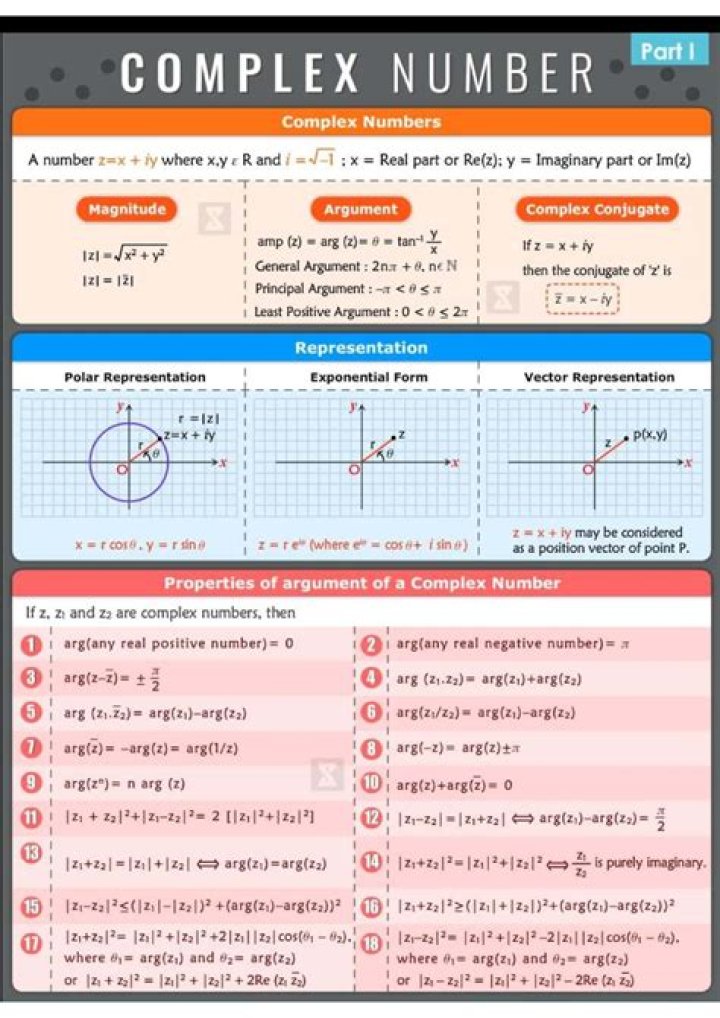
An efficient approach relies on use of Cartesian-to-polar coordinate transformation. To that end, let $z=x+iy=\sqrt{x^2+y^2} e^{i\arctan2(x,y)+i2\ell \pi}$. Then, the square root of $z$ is given by
$$\begin{align}\sqrt{z}&=\sqrt{x+iy}\\\\&=\sqrt{\sqrt{x^2+y^2}\,e^{i\arctan2(x,y)+i2\ell \pi}}\\\\ &=(-1)^{\ell}(x^2+y^2)^{1/4}e^{i\frac12\text{arctan2}\,(x,y)}\\\\ &=\bbox[5px,border:2px solid #C0A000]{(-1)^{\ell}(x^2+y^2)^{1/4}\left(\sqrt{\frac{1+\frac{|x|}{\sqrt{x^2+y^2}}}{2}} +i\sqrt{\frac{1-\frac{|x|}{\sqrt{x^2+y^2}}}{2}} \right)} \tag 1\\\\ \end{align}$$
where $\ell $ is any integer and $\arctan2(x,y)$ is the arctangent function with $2$ arguments.
Note that $(-1)^\ell = \pm 1$. Then, for $x=\sqrt 2$ and $y=1$, $(1)$ becomes
$$\begin{align}\sqrt{\sqrt 2+i}&=\pm 3^{1/4}\left(\sqrt{\frac{1+\frac{\sqrt 2}{\sqrt{3}}}{2}} +i\sqrt{\frac{1-\frac{\sqrt 2}{\sqrt{3}}}{2}} \right)\\\\ &=\bbox[5px,border:2px solid #C0A000]{\pm \left(\sqrt{\frac{\sqrt 3+\sqrt 2}{2}} +i\sqrt{\frac{\sqrt 3-\sqrt 2}{2}} \right)} \end{align}$$
And we are done!
$\endgroup$