Why is the tangent of 22.5 degrees not 1/2?
Sorry for the stupid question, but why is the tangent of 22.5 degrees not 1/2? (Okay... I get that that the tangent of 45 degrees is 1 ("opposite" =1, "adjacent" =1, 1/1 = 1. Cool. I am good with that.) Along those same lines, if the "opposite" drops to 1/2 relative to the "adjacent" i.e., "opposite" = 1, "adjacent" = 2 therefore 1/2. What am I missing? Thanks in advance for your help.
$\endgroup$ 18 Answers
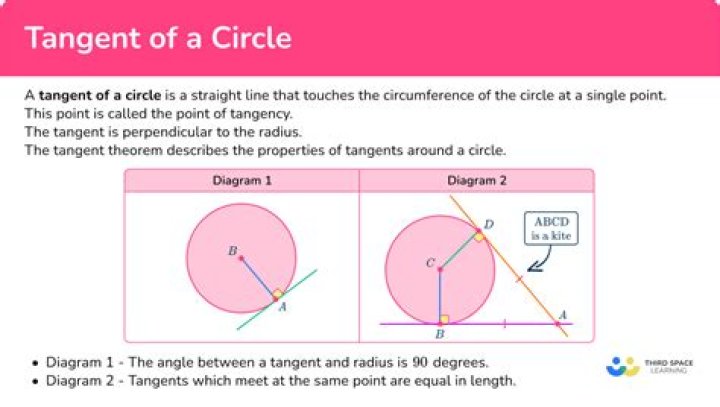
$\begingroup$It helps to realize that the tangent of an angle can be viewed as the length of a segment tangent to the unit circle (hence the name):
As the above helps illustrate, as an angle sweeps from 0 to 90 degrees, the corresponding value of tangent ranges from 0 to infinity. Behavior that exotic cannot reasonably be expected to follow a simple rule like "halving the angle halves the tangent"; just look at the reverse: Doubling a $45^\circ$ angle does a lot more than double its tangent value!
I'll leave you to ponder the deeper implications.
$\endgroup$ $\begingroup$Tangent is not a linear function. Halving the angle doesn't halve the tangent.
More formally, you are assuming $$\tan\left(\frac{\theta}{2}\right)=\frac{1}{2}\tan\theta$$ This is not generally true.
$\endgroup$ $\begingroup$Try to convince yourself that $$\sqrt{t^2+s^2}\gt t$$ thus $$\tan 22.5^{\circ}=\frac{t}{t+\sqrt{t^2+s^2}}<\frac{1}{2}$$
See tangent is perfectly defined as opposite by adjacent but when we half an angle it doesn't mean the corresponding side also gets halved except in cases of isosceles and equilateral triangle in which angle bisectors and medians are same that too in case of isosceles only if drawn from the vertex. So here the logic won't work instead u have to derive it geometrically in some other way.
$\endgroup$ $\begingroup$Because you are using values obtained from the unit circle, you need to first understand that. Go to the unit circle of 22.5 and see the corresponding values of sin and cos and use tan=sin/cos
$\endgroup$ $\begingroup$You already received good answers to your question explaining why you cannot do it.
Forget the specific case of an angle of $\frac{\pi}4$ and consider the general trigonometric formula $$\tan(2a)=\frac{2\tan(a)}{1-\tan^2(a)}$$ and for conveniency, let us note $y=\tan(2a)$ and $x=\tan(a)$ to arrive to $$y=\frac{2x}{1-x^2}$$ which is a quadratic equation in $x$ and the solution is given by $$x=\frac{\sqrt{y^2+1}-1}{y}$$ Now, suppose that $y$ is small and let us use Taylor series built at $y=0$; this leads to $$x=\frac{y}{2}-\frac{y^3}{8}+\frac{y^5}{16}+O\left(y^6\right)=\frac{y}{2}\Big(1-\frac{y^2}{4}+\frac{y^4}{8}\Big)+O\left(y^6\right)$$ So, if $\frac{y^2}{4}<<1$, we have $x\approx \frac{y}{2}$ as a very first approximation. So, for small angles, you could approximate $\tan(a)$ by $\frac{1}{2}\tan(2a)$.
For illustration purposes, consider the case of $a=\frac{\pi}{30}$; this corresponds to $y=\tan(\frac{\pi}{15})\approx 0.2125565617$ for which $\frac{y^2}{4}\approx 0.01129507298$ and $\frac y2 \approx 0.1062782808$ while the value of $x=\tan(\frac{\pi}{30})\approx 0.1051042353$. For this specific case, we then face an error of $1$% which is not bad for an approximate calculation.
$\endgroup$ $\begingroup$here is how you can see/reason this geometrically. draw a unit square $OABC$ and inside it draw quarter of a circle with $O$ as the center. draw the diagonal $OC$ from the center $O$ to the opposite vertex $C$ which cuts the circle at $F.$ let $D$ be the mid point of $AB.$ draw the line $OD$ let it cut the circle at $E.$ the tangent of $\angle AOD$ is $\frac12.$
we want to argue that the $arc\, AE > arc\, EF$ so that $\tan^{-1}(1/2) > 45^\circ/2.$ this can be explained by saying that the $arc\, AE$ is more parallel to $AB$ than the $arc\, EF.$ this is only an intuitive explanation; not rigorous at all.
$\endgroup$ $\begingroup$The basic error being made is the assumption that you are converting one unit into another unit such as when you convert meters into yards. Degrees are units but tangent represents a ratio.
$\endgroup$