Why is the absolute value of a complex number the same as its magnitude?
I don't really understand why the absolute value of a complex number is defined as its magnitude.
The absolute value for a real number, I think has two sensible interpretations: the magnitude of this number from the origin or the positive value of this number.
When extrapolating this to complex numbers, why is the first definition chosen, and not simply that the absolute value of a complex number is a complex number in the first quadrant (of the complex plane).
$\endgroup$ 24 Answers
$\begingroup$In general, we invent definitions and notation because we intend to make use of them somewhere. For example, the term "absolute value" and the corresponding notation $|-|$ exist because we regularly have occasion to refer to it in e.g. the definitions of variance of a random variable, limit of a sequence, and other constructions. For every one of these applications, the corresponding concept in the complex numbers is captured by magnitude. In contrast, I cannot think of a single case where I have needed to refer to "the number in the first quadrant differing from this one by a factor of a power of $i$."
Moreover, the useful algebraic properties of the absolute value function on the reals are not true of the function you've described. For example, if we denote your function by $[-]$, it is not the case in general that $[xy] = [x][y]$ -- how could it be, since the first quadrant isn't even closed under multiplication?
The point is, you can define whatever function you want, but if it's just a curiosity and not something that comes up naturally then it's probably not worth endowing with its own special notation and terminology.
$\endgroup$ 1 $\begingroup$I think you chose the wrong analogy.
How about this instead: rotate your given complex number by such an angle that the result is on the positive real axis. You can think of the real absolute value as doing just that, after all.
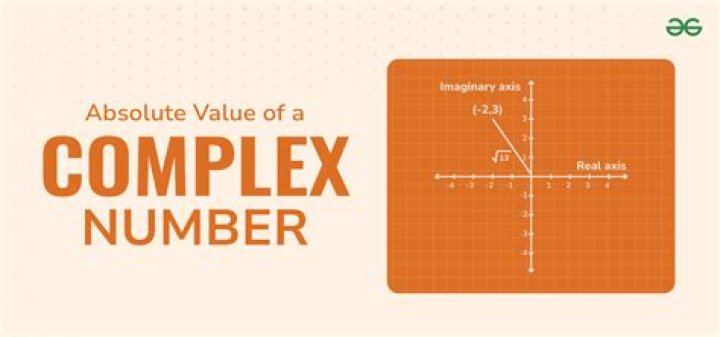
"The positive value of the number" is the effect of taking the absolute value of a real number, not the definition of absolute value. The actual definition of absolute value is a number's distance from zero. This is why the absolute value of a complex number is a positive real number, because distance is a real number.
Secondly, you can't argue that a complex number in the first quadrant of the complex plane is positive, since the imaginary unit ($i$) is considered neither positive nor negative.
$\endgroup$ 9 $\begingroup$Think of the imaginary number i as a rotation. Since i^2 = -1 and i^4 = 1, the imaginary number does not change magnitude but does change direction, which is why the absolute value is one and the same. Moreover, say you want to find the magnitude of z = a + bi. It follows that magnitude z = sqrt(|z|^2). Since i and -i are rotations in opposite directions, combining both rotations should bring one back to their original location. For this reason, we can say |z|^2= |z* z| where z* is the conjugate of z.