Why is $(-\infty,\infty)$ the domain of $\tan^{-1}(\theta)$?
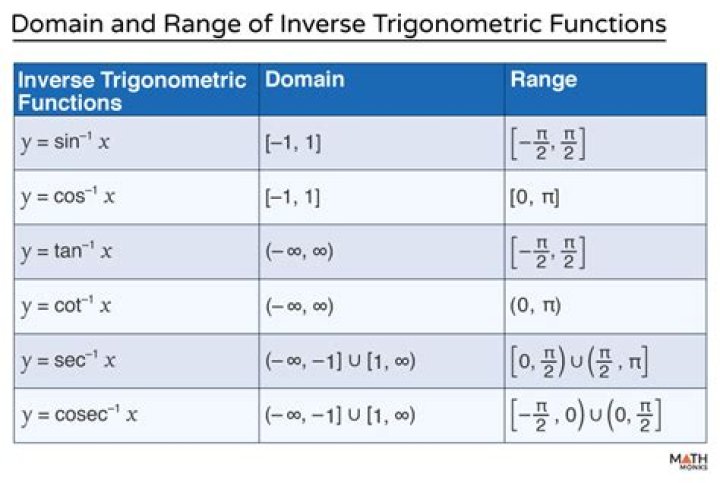
Please could someone explain me why domain of $\tan^{-1}(\theta)$ is $(-\infty,\infty)$
This is inverse below
$\tan^{-1}(x-6) + \frac{3π}{2}$ Context: I'm learning inverse trig on Khan Academy.
$\endgroup$ 23 Answers
$\begingroup$The tangent function is not invertible, because it's not injective, being periodic. However, if we restrict it to the interval $(-\pi/2,\pi/2)$, it is injective. Indeed, if $x,y\in(-\pi/2,\pi/2)$ and $\tan x=\tan y$, we have $$ \sin x\cos y-\cos x\sin y=0 $$ so $\sin(x-y)=0$. By the assumption, $$ -\pi<x-y<\pi $$ so the only solution of $\sin(x-y)=0$ is $x-y=0$.
The arctangent function (sometimes denoted by $\tan^{-1}$, but I prefer $\arctan$) is the inverse of $\tan$ restricted to $(-\pi/2,\pi/2)$.
It remains to find the range of $\tan$ in this interval. Let $t>0$ and construct a right triangle having legs $1$ and $t$. If $\alpha$ is the acute angle adjacent to the side with length $1$, then $\tan\alpha=t$.
Thus the range of $\tan$ (restricted to $(-\pi/2,\pi/2)$) contains every positive number. It also contains every negative number, since $\tan(-\alpha)=-\tan\alpha$ and it also contains $0$. Thus the range is $(-\infty,\infty)$ and this is the domain of the arctangent.
$\endgroup$ $\begingroup$This all comes from the relationship between a function, $f$, and its inverse, $f^{-1}$.
Remember that if $f(x) = y$, then the inverse function is defined so that $f^{-1}(y) = x$; inverse functions are designed to make input and output trade places. It's important here because it means that the range of $f$, the set of outputs, becomes the domain of $f^{-1}$, the set of inputs.
So, to understand why the domain of $\tan^{-1}(\theta)$ is $(-\infty, \infty)$, we need to understand why the range of $\tan(\theta)$ is $(-\infty, \infty)$.
For each angle $\theta$, we get a point $P_\theta = (x, y)$ on the unit circle. Then our tangent is
$$\tan(\theta) = \frac{y}{x},$$ and we can think of it as the slope of the line connecting the origin $(0, 0)$ to our point $P_\theta$. We can draw a line with any slope through the origin, so we can always find some angle $\theta$ that makes $\tan(\theta)$ equal to whatever number we like.
That's one way to see why the range of $\tan(\theta)$ is $(-\infty, \infty)$, and since $\tan^{-1}(\theta)$ is the inverse function of $\tan(\theta)$, its domain also has to be $(-\infty, \infty)$.
$\endgroup$ $\begingroup$$\tan t$ is defined as the ratio of $\sin t$ to $\cos t.$ even though $\sin t$ and $\cos t$ are limited to between $-1$ and $1$ by the constraint $$\sin^2 t + \cos^2 t = 1,$$ there is no such constraint on the size of $\tan t.$ in fact the constraint demands that when $\sin t = \pm 1, \cos t= 0$ this ration becomes undefined. i hope you can now see that $tan t$ can take any value. consequently the domain of the inverse tangent is all real numbers.
$\endgroup$