Why $\frac{d\theta}{dt}=\frac{x}{r^{2}}\frac{dy}{dt}-\frac{y}{r^{2}}\frac{dx}{dt}$?
As the title shows this question concerns nothing but chain rule. We now have:
$$\frac{d\theta}{dt}=\frac{x}{r^{2}}\frac{dy}{dt}-\frac{y}{r^{2}}\frac{dx}{dt}$$
I am assuming by chain rule we have $$\frac{d\theta}{dt}=\frac{d\theta}{dx}\frac{dx}{dt}+\frac{d\theta}{dy}\frac{dy}{dt}$$
But we have $$\theta=\arccos[\frac{x}{r}]=\arcsin[\frac{y}{r}]$$
Thus taking the derivative we should assume $$\frac{d\theta}{dx}=-\frac{1}{y},\frac{d\theta}{dy}=\frac{1}{x}$$ because $$\frac{d}{dx}\arccos[\frac{x}{r}]=-\frac{1}{r\sqrt{1-\frac{x^{2}}{r^{2}}}}=-\frac{1}{\sqrt{r^{2}-x^{2}}}=-\frac{1}{y}$$
However we know $$-\frac{y}{r^{2}}\not=-\frac{1}{y}$$ I computed this a few times but do not know where I got wrong. The relationship in the title is in Berkeley Problems in Mathematics.
$\endgroup$ 201 Answer
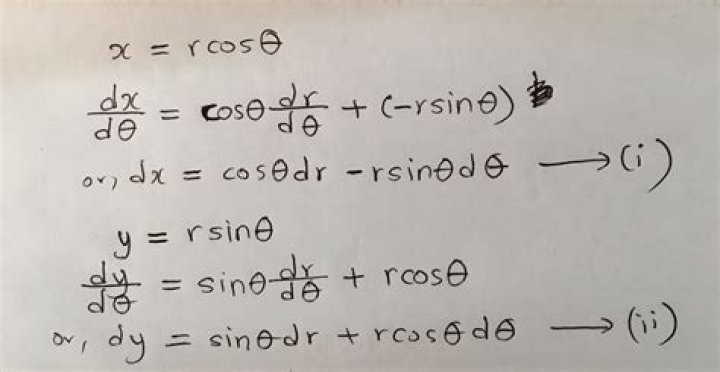
$\begingroup$After the clarification (polar coordinates) and summarizing the answers given in the comments above: $$x=r\cos\theta\,\,,\,\,y=r\sin\theta\,\,\,,\,\,r\geq0\,,\,\,\theta\in [0,2\pi]$$ I'm assuming the radius is always non-negative, though not all do this.
From the above, $\,\theta=\arctan\frac{y}{x}\,\,,\,x\neq 0$ (the case $\,x=0\,$ is an easy particular case depending on the sign of $\,y\,$), so if both rectangular coordinates are derivable functions of some parameter $\,t\,$, we'd get: $$\frac{d\theta}{dt}=\frac{d\theta}{dx}\frac{dx}{dt}+\frac{d\theta}{dy}\frac{dy}{dt}$$ $$\frac{d\theta}{dx}=-\frac{y}{x^2}\frac{1}{1+\left(\frac{y}{x}\right)^2}=-\frac{y}{x^2+y^2}$$ $$\frac{d\theta}{dy}=\frac{1}{x}\frac{1}{1+\left(\frac{y}{x}\right)^2}=\frac{x}{x^2+y^2}$$
Observe that writing the expressions for $\,x,y\,$ from the beginning you get two differential equations. I'll leave this here as I'm not completely sure whether this already answers your question.
$\endgroup$ 1