why doesn't proof of sum of two rational number is rational not proving the irreducibility of fraction $\frac{ad+bc}{bd}$?
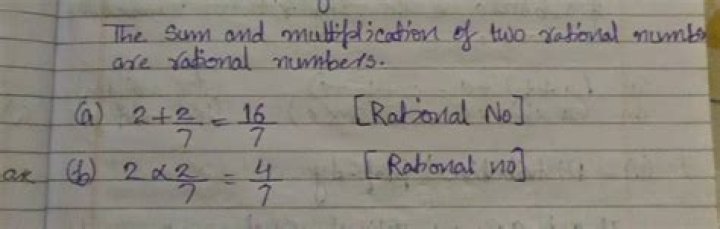
When I was comparing proof for $\sqrt{2}$ and sum of two rational numbers, I found that the proof of two rational number did not mention anything about common factor in the ratio.
one proof I found for sum of two rational numbers:
The sum of any two rational numbers is rational.
Proof.
Suppose r and s are rational numbers. [We must show that r + s is rational.] Then, by the definition of rational numbers, we have
r = a/b for some integers a and b with b ≠ 0. s = c/d for some integers c and d with d ≠ 0.So, by substitution, we have
r + s = a/b + c/d = (ad + bc)/bdNow, let p = ad + bc and q = bd. Then, p and q are integers [because products and sums of integers are integers and because a, b, c and d are all integers. Also, q ≠ 0 by zero product property.] Hence,
r + s = p/q , where p and q are integers and q ≠ 0.
Therefore, by definition of a rational number, (r + s) is rational. This is what was to be shown.
And this completes the proof.
Unlike $\sqrt{2}$ proof which state that because both p and q for p/q is prove to be even, therefore contradicting the premises that it is a irreducible faction, The sum proof did not mention if $\frac{ad+bc}{bd}$ might have a common factor , hence make this proof incomplete. Why is that?
$\endgroup$ 31 Answer
$\begingroup$There is nothing incomplete in the proof. The proof shows the following statement:
If there exist such integers $a,b$ that $r=\frac ab$ and there exist such integers $c,d$ that $s=\frac cd$, then there also exist such integers $p, q$ that $r+s = \frac pq$.
Remember that this is all you need. A number $x$ is rational if and only if there exist some integers $m,n$ so that $x=\frac mn$.
The fact that there also exist two (almost) uniquely determined coprime integers $m', n'$ such that $x=\frac{m'}{n'}$ does not mean that every pair of integers that forms $x$ is coprime, only that one such pair exists.
On the other hand, for $x=\sqrt 2$, the proof shows that no such pair exists.
$\endgroup$ 2