Why does uniform continuity of a function imply that the function is bounded? [duplicate]
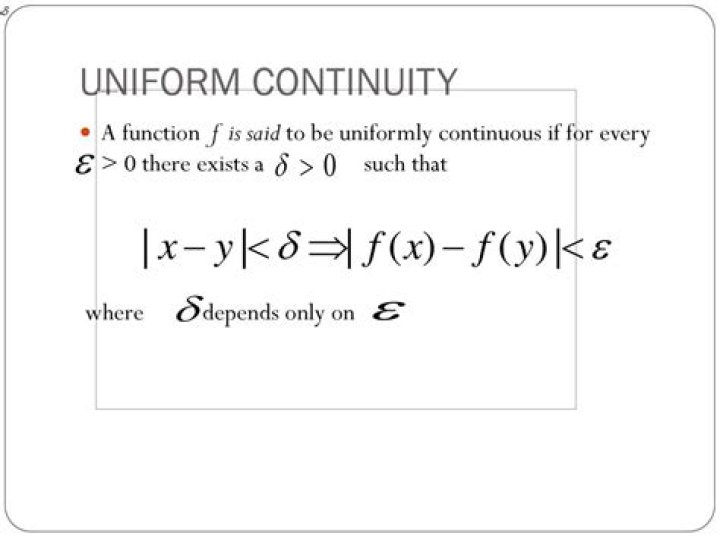
As the title states, I'm wondering why:
If $A$ is a bounded subset of $\mathbb{R}$ and $f:A\to \mathbb{R}$ is uniformly continuous on $A$, then $f$ must be bounded on $A$.
Proof:
Since it is uniformly continuous, the function is a Lipschitz function.
$|f(x)-f(y)| \leq L|x-y|$.
Since $A$ is bounded, $|x-y|$ does not get arbitrarily big and that too is bounded by a constant. Let $|x-y| \leq M$.
Then we have a Lipschitz condition where
$|f(x)-f(y)| \leq LM$.
The function is then bounded by the product of two constants, $LM$, which means that it is bounded. Can someone check this?
$\endgroup$ 82 Answers
$\begingroup$Hint: Since $f$ is uniformly continuous, there is a constant $M$ so that $$ |x-y|\le1\implies|f(x)-f(y)|\le M $$ Thus, $f$ is bounded on each interval $[k,k+1]$. Since $A$ is bounded, you can cover it with a finite number of such intervals.
$\endgroup$ 6 $\begingroup$If not $\forall~n\in\mathbb Z^+,~\exists~a_n\in A$ such that $f(a_n)>n.$
$(a_n)_n$ being bounded it has a convergent subsequence $(a_{r_n})_n.$
Thus $(a_{r_n})_n$ is a Cauchy sequence in $A$ which maps to a non Cauchy sequence in $\mathbb R,$ a contradiction.
$\endgroup$