Why are two and three the only consecutive prime numbers?
I've learned that two and three are not only two consecutive numbers, but are also two consecutive prime numbers. How is this possible? I think I'm on the right track in the following text: The numbers two and three are prime numbers because they both have two factors: $1$ and itself and the other numbers divisible by two are all composite, so these are the only prime numbers that are consecutive. Does this help you or am I on the right track? Answer either of these questions, too, and I'd love to hear a shout from you about what you know!
$\endgroup$ 43 Answers
$\begingroup$Out of every two consecutive numbers one will always be even. There is only one even prime number.
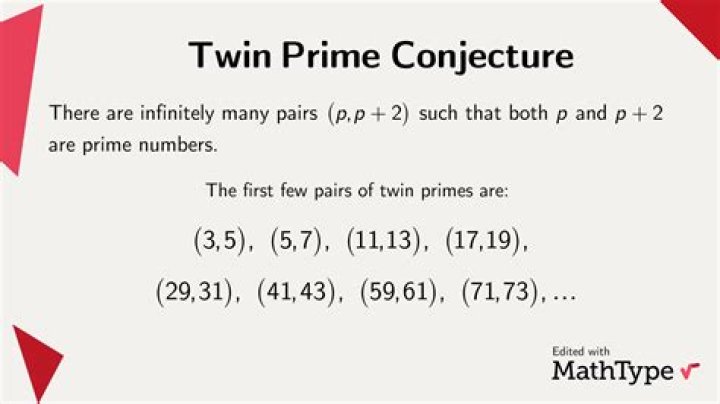
Whether there are an infinite number of pairs of primes which differ by two (the twin prime conjecture) is still open e.g. $3,5; 41, 43; 101,103$. A significant amount of progress has been made recently, but a new idea is likely to be required to crack the problem.
$\endgroup$ 2 $\begingroup$Since 2 is the only prime even number, It's possible because the next even number, 4, is a composite number, as is every single even number after that because they are all evenly divisible by 2. Because of all the even numbers starting with 4 are composite, it's impossible to have two more prime consecutives. Or another way to say it is that when you identify a prime number, it's guaranteed that the number immediately preceding it, as well as the number succeeding it are going to be composite.
$\endgroup$ $\begingroup$2 and 3 are only consecutive prime numbers as 2 is the only even prime number and after that each consecutive pair contains one even and another odd number.
$\endgroup$