Why are orthogonal projection matrices not ... orthogonal?
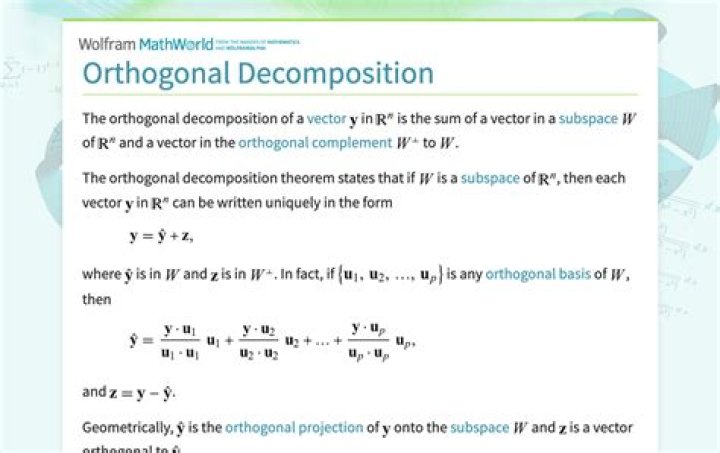
I know that given an orthogonal matrix U, then orthogonal projection onto the column space of U is represented by the matrix $UU^t$, which is again orthogonal. I've computed these types of matrices many times now.
But when reading online sources such as Wolfram, they give examples of orthogonal projection matrices with a zero column or a zero row, and a couple of 1s - such as the well-known matrix that projects (x,y,z) to (x,y,0).
But this matrix doesn't even have full rank, let alone be unitary or orthogonal.
Where's my conceptual mistake?
Thanks,
$\endgroup$ 22 Answers
$\begingroup$You seem not to have noticed a few things about those calculations you say you've done many times. Given an orthogonal matrix $U$, in fact $UU^T$ is the identity matrix. So yes it is "again orthogonal", but that's a curious way to put it. And yes it is the projection onto the column space of $U$, because in fact that column space is all of $\Bbb R^n$.
On the other hand, if $P$ is the matrix that gives the orthogonal projection onto a proper subspace $V$ of $\Bbb R^n$ then $P$ cannot be orthogonal. An orthogonal matrix maps $\Bbb R^n$ onto itself, while $P$ maps $\Bbb R^n$ onto $V$. So the rank of $P$ should be the dimension of $V$, which is less than $n$.
$\endgroup$ 1 $\begingroup$Concept "orthogonal matrix" (inverse is transpose) vs concept "orthogonal projection" (self adjoint, idempotent).
$\endgroup$ 2