Which is better, heat sink or fan-cooled components? [closed]
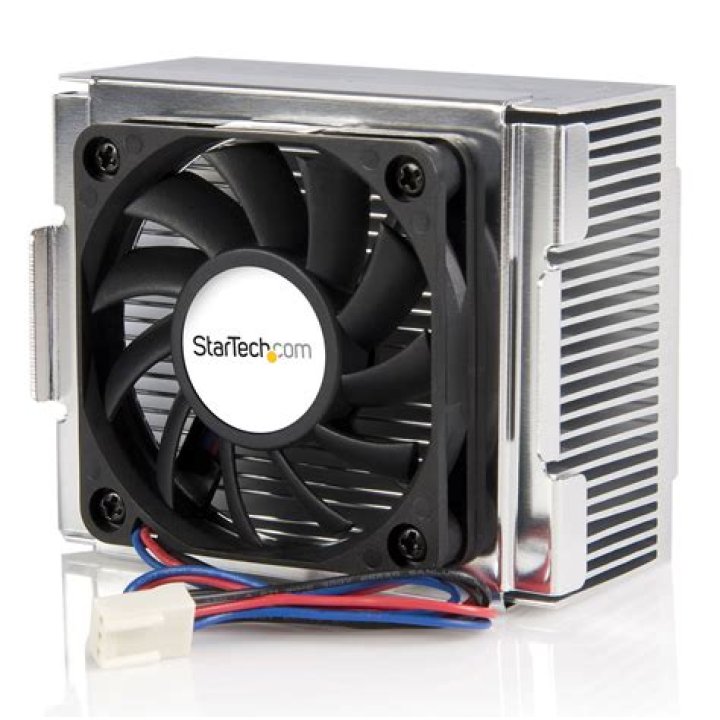
Fans have been the common cooling method in hardware for a long time. However, fans depend on moving parts and therefore require maintenance and have a limited lifespan.
An alternative cooling method in use today is the heat sink. Heat sinks have also been around quite a while and can be found in everything from motherboards to cooling CPUs. Many heat sink cooled GPUs such as the XFX One pictured below are available to consumers. There are even high end heat sink PSUs:
Rosewill SilentNight Series 500
Heat sink products are touted for their quiet, low maintenance and durability, but are they really as reliable as we'd like to imagine?
What are the advantages and disadvantages of going fanless? Are there cooling limits for heat sinks to compare with fans? Has anyone tested with real world use how long heat sink cooled components last in comparison to ones with fans? Can such components replace those with fans entirely?
4 Answers
A solution involving a fan will also include some kind of heatsink. It's not like you are removing a heatsink and replacing it with just a fan, the fan will be integrated with some kind of heatsink as well. Generally though, with good airflow provided by the fan heatsinks can often be a lot smaller.
The only benefit to a heatsink-only arrangement is less noise. It will not improve the reliability of the underlying hardware and in the case that the enclosure the heatsink is in has poor airflow could make things a lot worse.
Yes the fan is "yet another" component that can fail but what it gives you is the active movement of air which draws heat off of the heatsink, without that active movement you rely exclusively on convection to get cool air to the heatsink fins.
Take the graphics card for example...
If the graphics card heatsink is facing downwards (as is common in a desktop PC) then you will end up with hot air pooling underneath it, potentially raising the average temperature by a significant amount. Out of preference you want the heatsink fins to be standing upwards so that hot air can immediately rise off of it and cool air be pulled in. By necessity going to a heatsink only arrangement means you need to look very carefully at component placement and orientation, something you care less about with fans pushing the air around.
Heatsinks alone also cannot keep a device as cool as a heatsink and fan arrangement. Generally in order to remove a fan you need to have several times the surface area to radiate heat off of. With high power devices that can make heatsinking impractical. I've seen only a couple of high end fanless current generation cards and they all took up 3-4 slots just to get a large enough heatsink. They were either massive metal beasts, or were from the bottom of the range.
These considerations affect how and where you would use a fanless card. You would not use it in a bleeding edge gaming rig because it would take up most of the case, you could use it in a small home theatre PC so long as you had some airflow and didn't expect to play next-gen games on it, you could easily use it in a workstation PC quite happily.
Fans, generally, are highly reliable and dirt cheap to replace. The technology is mature and quality is generally pretty high across the board.
I'd only go fanless for a machine that I knew was pulling limited duty.
As to reliabilityfor fanless components you are basically exchanging the reliability of the fan for the belief (or hope) that the person who specified the heatsink has done their homework properly. That person has to have spent time working out the heat capacity of the metal, made sure that the thermal resistance of the block is low enough and that it has a large enough area to radiate that heat away under higher ambient temperatures. Granted a lot of that work has to be done for fanned parts, but fans can remove heat a lot better than stagnant air.
The actual component reliability should be the same as they are the same basic parts. The difference comes when the heatsink is underspecified or slightly too small.
3Heat sink is strategically located such that it sucks the heat from the processor and other such parts and then directs it to the area near the exhaust.
However, if there is little air movement near the exhaust, the heat may take considerable time to escape. This is more prominent when you are using laptop (any other such device) for longer duration of time.
So, it is always advisable to invest in both the utilities. Fan makes sure that whatever heat is brought to the exhaust by the sink gets removed quickly.
Heat sinks are expensive and require a less maintenance (once a year maybe..)
In a high end system you can't avoid having both easily. The heatsink would have to be so massive it would have to have its own support legs to prevent its weight and/or size from breaking the printed circuit board of the device your trying to cool and/or the motherboard.
On a low/medium end system a heatsink is enough, but they are still dust magnets and need to be periodically cleaned.
Fans allow the heatsink to be much smaller, and you can usually find a replacement for $9.99 or less. The heatsink fan combo offers the best cost friendly solution. You could easily buy 10+ fans for the cost of a plain heatsink capable of cooling a Radeon r9 Fury X or a high end CPU.
More options...
Water cooling kits:
Heat pipes:
Both these might be more effective, and still be even less noisy than a pure fan and heatsink.