What is the value of $\arctan(y/x)$ for $y=0$?
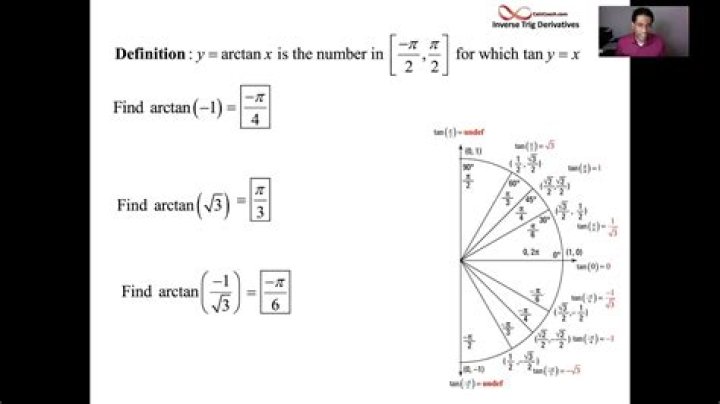
What is the value of $\arctan(y/x)$ for $y=0$?
Must it depend on the value of $x$?
I seem to be getting $$\arctan(y/x) = \begin{cases} 0, x > 0 \\ \pi, x < 0 \\ \end{cases} $$ if I restrict my arctangent on $(-\pi, \pi]$. Is this correct?
Added September 16 2017
Per this Wikipedia link, the range of the usual principal value of $\arctan z$ is indeed in $(-{\pi/2},{\pi/2})$. Hence, indeed $\arctan(y/x) = 0$ when $y = 0$.
$\endgroup$ 101 Answer
$\begingroup$Not sure what you're asking...
$$\arctan\left(\frac 0 x\right) = \arctan(0) = 0$$
For all $x \neq 0$
Edit in the case of polar coords, complex numbers, etc...
You are correct that, $x \in \mathbb R$,
$$\arg(x+0i) = \begin{cases} \arctan(0), \ \ \ \ \ \ \ \ \ x\ge 0 \\ \arctan(0)+\pi, \ \ x<0\end{cases}$$ $$\arg(x+0i) = \begin{cases} 0, \ \ \ \ \ \ \ \ \ x \ge 0 \\ \pi, \ \ \ \ \ \ \ \ x<0\end{cases}$$
Remember that $\arctan$ remains single-valued under the typical interpretation. (though you can redefine it as a multifunction of some sorts)
To verify, you can observe that
$$\exp(0) = i\sin 0 + \cos 0 = 1$$ $$\exp(i\pi) = i\sin \pi + \cos \pi = -1$$
$\endgroup$ 0