What is the ordinary definition of a saddle-point?
Suppose $f:\mathbb{R}^2 \to\mathbb{R}$ is a $\mathcal{C}^2$ function such that both first-order partial derivatives vanish at the origin. Under what circumstances would you say that $f$ has a saddle-point at the origin?
If the Hessian of $f$ is nonsingular, then this question is not interesting, so I suppose I am really asking when a function $f$ having a stationary point at the origin and whose Hessian is singular there has a saddle-point. Consider as examples the obvious saddle-point $f(x,y) = x^4 - y^4$, the slightly less obvious case of $f(x,y) = x^3-y^3$, and the very peculiar case of $f(x,y) = \sin(1/(x^2 + y^2))\exp(-1/(x^2+y^2))$ extended to $\mathbb{R}^2$ by setting $f(0,0)=0$.
$\endgroup$1 Answer
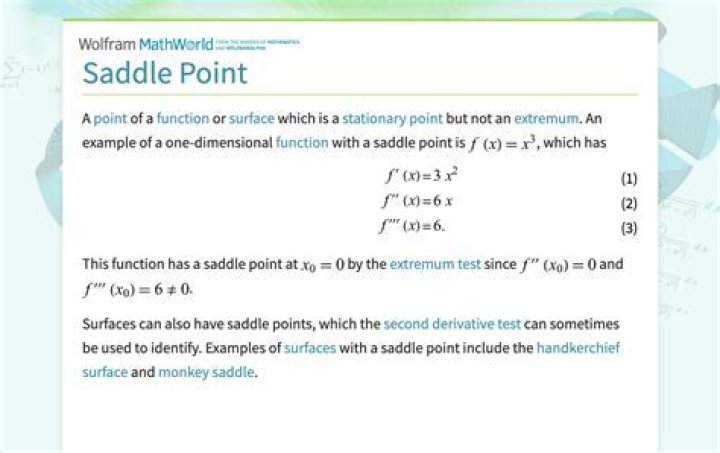
$\begingroup$A saddle point is a critical point that's not a local maximum or minimum; in other words, a point $p$ with $\nabla f(p)=0$ and the property that for all $\epsilon>0$, there exist two points $q_1$ and $q_2$ with $\|p-q_1\|<\epsilon$, $\|p-q_2\| < \epsilon$, and $f(q_1) < f(p) < f(q_2)$.
If $f$ is only $C^2$ there's no way to characterize such functions by looking only at $f$'s derivatives at $p$ (since like you point out all bets are off at points where both the gradient and Hessian vanish.) Perhaps more could be said if $f$ is smooth.
$\endgroup$ 4