What is the implication of Perron Frobenius Theorem?
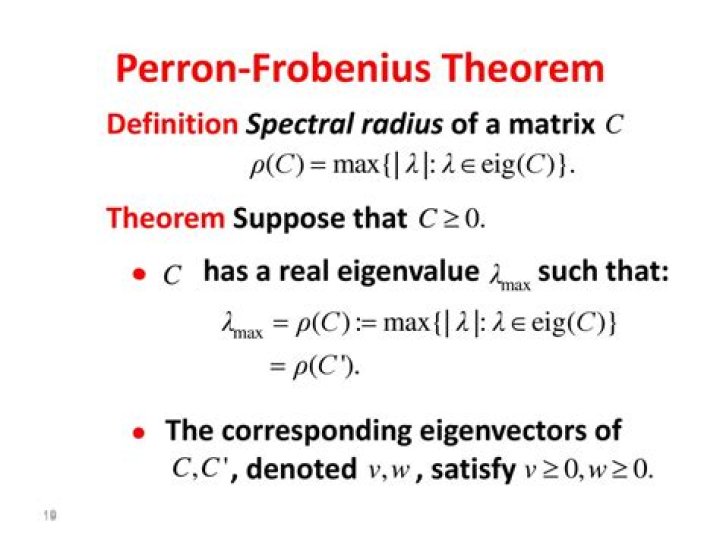
The Perron Frobenius theorem states:
Any square matrix $A$ with positive entries has a unique eigenvector with positive entries (up to a multiplication by a positive scalar), and the corresponding eigenvalue has multiplicity one and is strictly greater than the absolute value of any other eigenvalue.
So I tempted fate using this matrix:
$$ A =\begin{bmatrix} 1 & 1 \\ 1 & 1 \end{bmatrix}$$
I find my eigenvalues to be $\lambda_1 = 0, \lambda_2 = 2$
Now I find my eigenvector, taking $v_{11} = 1$, $v_{21} = 1$
I find $v_1 = \begin{bmatrix} v_{11} & v_{12} \end{bmatrix}$ = $\begin{bmatrix} 1 & -1 \end{bmatrix}$
$v_1 = \begin{bmatrix} v_{21} & v_{22} \end{bmatrix}$ = $\begin{bmatrix} 1 & 1 \end{bmatrix}$
This verifies the Perron-Frobenius theorem.
Now what is the great implication that every positive square matrix has a real eigenvector with an eigenvalue that is the largest of all eigenvalues?
Can someone show me an application of this theorem?
$\endgroup$ 17 Answers
$\begingroup$The Perron-Frobenius theorem is used in Google's Pagerank. It's one of the things that make sure that the algorithm works. Here it's explained why the the theorem is useful, you have a lot of information with easy explanations on Google.
$\endgroup$ 1 $\begingroup$For example, there are important applications in the theory of finite Markov chains. Among other things, it implies that a Markov chain with strictly positive transition probabilities has a unique stationary distribution.
$\endgroup$ 2 $\begingroup$First of all, the conclusion is more interesting if you also try an example where the matrix entries are still real, but not positive. For example, if $A$ is the $2\times2$ rotation matrix $$A=\pmatrix{\cos\theta&\sin\theta\\ -\sin\theta&\cos\theta}$$ then you can check that the eigenvectors are no longer real, and there's no longer a unique eigenvalue of maximum modulus: the two eigenvalues are $e^{i\theta}$ and $e^{-i\theta}$.
I second Robert Israel's nomination of Markov chains as a great application. I'll add the following, though. (I'll remark that you don't actually need the matrix to have positive entries - just for some power of it to have positive entries.) Suppose you have a finite connected graph (or strongly connected digraph) such that the gcd of the cycle lengths is $1$. Then if $A$ is the adjacency matrix for the graph, some power $A^r$ will have positive entries so Perron-Frobenius applies. Since the entries of $A^n$ count paths in the graph, we conclude that for any pair of vertices in the graph, the number of paths of length $n$ between them is $c\lambda_1^n(1+o(1))$, where $\lambda_1$ is the Perron-Frobenius eigenvalue and $c$ is a computable constant. Applications of this particular consequence of Perron-Frobenius include asymptotic growth rate results for "regular languages," which are defined in terms of paths on graphs.
In particular, there is a cute formula giving the $n$-th Fibonacci number as $$F_n=\left\langle \frac1{\sqrt5}\phi^n\right\rangle$$ where $\phi$ is the "golden ratio" $(1+\sqrt5)/2$ and $\langle\cdot\rangle$ denotes "closest integer." This formula, and many others like it, become less surprising once you check that $$\pmatrix{1&1\\1&0}^n=\pmatrix{F_{n+1}&F_n\\ F_n&F_{n-1}}$$ and note that $\phi$ is the Perron-Frobenius eigenvalue (and the other eigenvalue is smaller than $1$ in absolute value.)
$\endgroup$ $\begingroup$I would like to add an engineering application. I am a researcher from a wireless communication background. One of the most fundamental problem in our area would be the so-called Power Control wherein a mobile tower transmitting individual data to the several mobiles has to minimize its own power consumption meanwhile ensuring a minimum level of signal quality at the mobile. This can be formalized as a non-convex optimization problem. However, using some theoretical tools based on the perron-frobenius theory, you can find a simple, iterative algorithm which finds the true solution to this problem. This result has been a break through in our field. The perron-frobenius eigenvector will be the sort of numbers (positive) which states how much power the mobile tower has to use to serve its users. A well-cited paper in this regard is "A framework for uplink power control in cellular radio systems", in case you are interested to read more about this.
$\endgroup$ $\begingroup$One of the nice things about it is that for $v$ a vector with all positive entries, if we let $v_k = A^k v$, then $\lim_{k\to\infty} \frac{v^k}{|| v_k ||}$ exists and is an eigen vector for the Perron-Frobenius eigen value.
$\endgroup$ 2 $\begingroup$I'll add an answer from the world of symbolic dynamics and tiling theory.
If you have a substitution on some alphabet $\mathcal{A}=\{a_1,\ldots,a_k\}$, say something like the Fibonacci substitution $$\sigma\colon\begin{cases}a\mapsto ab\\ b\mapsto a\end{cases}$$ then you have an associated transition matrix $M_{\sigma}$ where $m_{ij}$ is the number of times the letter $a_i$ appears in the word $\sigma(a_j)$. So for example the transition matrix for the Fibonacci substitution is $M_{\sigma}=\left(\begin{smallmatrix}1&1\\ 1&0\end{smallmatrix}\right)$.
Whenever there exists a $k$ such that $M_{\sigma}^k$ has strictly positive entries, we say that $\sigma$ is a primitive substitution. Transition matrices of primitive substitutions therefore satisfy the hypothesis of the Perron Frobenius theorem and we can say the following thanks to it.
Theorem Let $|w|$ be the length of a word. If $\sigma$ is a primitive substitution, then the PF eigenvalue $\lambda_{PF}$ has the property that $\lim_{n\to \infty} |\sigma^n(a_i)|/\lambda_{PF} = 1$ for any $a_i\in\mathcal{A}$. That is, the length of the words $\sigma^n(a_i)$ are roughly $\lambda_{PF}^n$.
If $v_{PF}$ is the associated dominant right eigenvector then the frequency of letters in the limit word $\sigma^{\infty}(a_j)$ is given by $\mbox{freq}(a_i)=(v_{PF})_i/\|v_{PF}\|_1$, and this is independent of choice of seed letter $a_j$.
We can use the left eigenvector to assign lengths to intervals in the line which are labelled by the symbols $a_i$, and we can then think of $\lambda_{PF}$ as being a natural expansion factor for a geometric substitution, whereby we apply $\sigma$ to the interval assigned the letter $a_i$ by expanding it by a factor of $\lambda_{PF}$ and then cutting it up into intervals of lengths associated to the eigenvector, and in the order prescribed by the substitution.
A good paper to read more about this stuff, including how we can similarly do substitutions in higher dimensions is this paper by Natalie Priebe-Frank.
$\endgroup$ $\begingroup$To check the stability of dynamical systems, one can try to search for a real-valued positive function named Lyapunov function.
If the dynamical system is LTI, that is, of the format $$ \dot{x}(t) = Ax(t) $$ or $$ x(k+1) = Ax(k),$$ one can restrict the search for quadratic Lyapunov functions, that is, for functions $V: \mathbb{R}^n \rightarrow \mathbb{R}$ of the format $V(x) = x^T P x$.
If the LTI system is also positive (that is, the state is always guaranteed to be in the positive orthant of $\mathbb{R}^n$), it is possible to use Perron-Frobenius theorem to prove that this search can be restricted to linear functions, simplifying even more the problem of stability analysis. For details, see slides 31-37 of Prof. Boyd's lecture notes on Perron-Frobenius theory.
You can also check the following reference for an embracing survey of applications:
Pillai, S. Unnikrishna, Torsten Suel, and Seunghun Cha. "The Perron-Frobenius theorem: some of its applications." IEEE Signal Processing Magazine 22.2 (2005): 62-75.
$\endgroup$