What is the distribution of the reciprocal of uniformly distributed random variables?
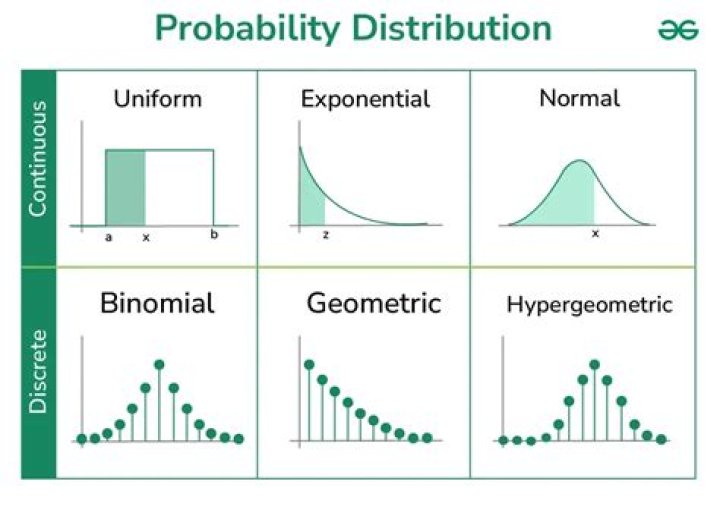
Suppose that $Y_n$ are random variables that are uniformly distributed in the range $[0,1]$, then I know that $P(Y\le y) = \frac{y-a}{b-a}$. What is the distribution of reciprocal $Z_n = \frac{1}{Y_n}$?
$\endgroup$ 12 Answers
$\begingroup$The cumulative distribution function for $Z=\frac{1}{Y}$ is $$P(Z\leq z) = P(Y \geq 1/z) =1-P(Y < 1/z)= 1-\frac{1}{z}$$ for $z \geq 1$.
The probability distribution function is the derivative of this function: $$ f(z) = \frac{1}{z^2}$$ for $z\geq 1$.
$\endgroup$ 1 $\begingroup$Congratulations! You have discovered a Pareto distribution. The answer above from Natha is correct, but there are a few things about this beastie that remain unsaid. For example, the mean and variance (and higher moments) do not exist. Since the central limit theorem relies on a finite variance, a lot of ordinary statistical practice is not applicable. Order statistics using quartile points and median are OK. Practitioners call this a "tail heavy distribution".
Play with it in a spreadsheet! Plot the cumulative average for a few hundred. You will see the average start to converge to a value, then jump wildly to a different value (because the uniform random number generator gave a value near zero). Very different from the uniform, normal, chisquare, or other distributions we study in college statistics.
$\endgroup$ 1