What is the difference between set notation and interval notation?
I was wondering if there is a difference between set notation and interval notation. For example is it the same to write $\{0,\infty\}$ and $(0,\infty)$?
I am asking this because in variable coefficient strictly linear PDEs at some point we need to choose a transformation which is invertible and one to one.
For this we need the Jacobian determinant $$J=\frac{\partial(\xi,\eta)}{\partial(x,y)}\neq\{0,\infty \}.$$
I would appreciate any help. Thank you.
$\endgroup$2 Answers
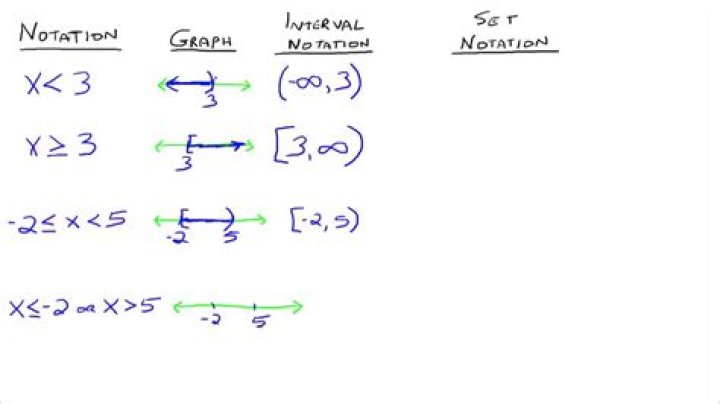
$\begingroup$Yes, there is a big difference. The set $\{0,\infty\}$ is the set containing two elements: $0$ and $\infty$ (whatever "$\infty$" means). The set $(0,\infty)$ consists of all real numbers strictly between $0$ and $\infty$; that is, all positive real numbers. So in fact, these sets don't even share any elements in common.
$\endgroup$ $\begingroup$Yes. "$\{...\}$" means "the elements of the set are $...$" - so e.g. $\{2, 3, 17\}$ is the set containing $2, 3, 17$, and nothing else - whereas "$(...,...)$" means "the elements of the set are everything between $...$ and $...$." So, for instance, $2\not\in \{0, \infty\}$ but $2\in (0, \infty)$.
In the specific case you mention, they're requiring that the Jacobian not be zero or infinity.
$\endgroup$