What is the difference between logarithmic decay vs exponential decay?
I am a little unclear on whether they are distinctly different or whether this is a 'square is a rectangle, but rectangle is not necessarily a square' type of relationship.
$\endgroup$ 13 Answers
$\begingroup$The "Square is a rectangle" relationship is an example where the square is a special case of a rectangle.
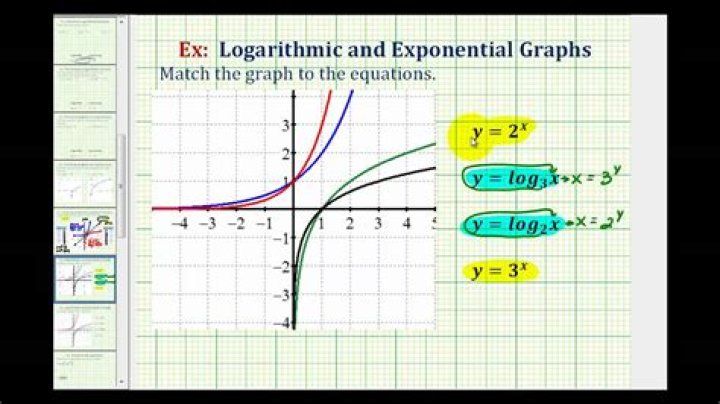
"Exponential decay" gets its name because the functions used to model it are of the form $f(x)=Ae^{kx} +C$ where $A>0$ and $k<0$. (Other $k$'s above $0$ yield an increasing function, not a decaying one.)
Similarly for "logarithmic decay," it gets its name since its modeled with functions of the form $g(x)=A\ln(x)+C$ where $A<0$.
These two families of functions do not overlap, so neither is a special case of the other. The giveaway is that the functions with $\ln(x)$ aren't even defined on half the real line, whereas the exponential ones are defined everywhere.
$\endgroup$ 1 $\begingroup$The natural logarithm and exponential are inverses of one another, so the associated slopes will also be inverses. If you put exponentially decaying data on a log plot, i.e. log of the exponential decaying data with the same input, you get a linear plot. If you put the logarithmic decaying plot on an exponential plot (exponential of the data), you get a linear plot, so the way they are decaying is exactly opposite.
$\endgroup$ 1 $\begingroup$Experiment with it by entering ln and exp in this online grapher: exp and ln graphs, how they are related and the influence of a vs -aImage: At school, we learn about exponentials being typically at how powerful exponential growth rates are e.g. birth rates reaching over population or growth of bacteria
e.g. h(x)=a * exp(x)+c
Log is rather indicating how it can take forever to reach certain limit, e.g. why - IF you take anti-biotics to kill a bacteria infection - you have to take them so long because you're always killing e.g. half of them the first day, then again half of that remaining half, etc. It explains why you feel good, so quickly. And also why you mustn't stop. Because in the remaining half or quarter, there's plenty of bacteria still and if just 1 manages to find a way around the anti-biotic thanks to a mutation, it will grow exponentially and make you sick again in a matter of days. And then you won't have any anti-biotic anymore to kill it off to zero = to the last single bacteria and keep taking the anti-biotic for a couple of days more, just to make sure you have killed them all.
e.g. f(x)=a * ln(x)+c
And then we learn how they are both linked and can be flipped, and pivoted by e.g. turning the a into -a.
Try it out.
Conclusion: exponential or logarithmic decay? An exponential decay can drill down under zero, a logarithmic decay can reach zero-eventually but not down under zero?
$\endgroup$ 0