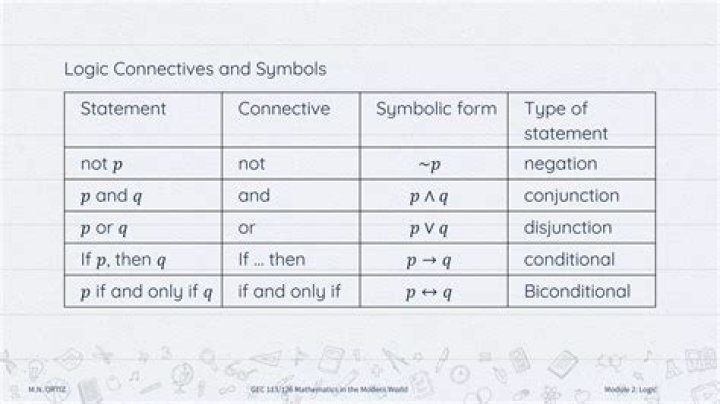
What is the conventional notation for these logic statements?
$\begingroup$
When I studied chemical engineering I often found the need to rewrite lecture notes, handouts and books in order to gain a thorough understanding of the subject I was reading. As much as time permitted I used to draw mindmaps of the reading material combining the symbols on the left in the image below:
The first ones are probably known, but some of these may need some explanation. I will list all of them with my own explantions to make clear what I mean.
- B is a part of A. B is a subset of A. B is a property of A.
- B is partly a part of A. B is a almost a subset of A. B is to a very small degree a property of A.
- A equals B. A and B are the same thing.
- B is a consequence of A. If A happens then B happens as a consequence.
- A becomes B. First there is only A, later there is only B.
- This describes a process or a verb. A is put into B. Example: A reactant (A) is fed into a reactor (B).
- A affects property B and causes a decrease, and B is a property of some other object as drawn in 1.
- A affects property B and causes an increase, and B is a property of some other object as drawn in 1.
- A intends to cause B to come into existance. Example: A company (A) strives to create profit (B).
- A strives/wants/intends to become B. Example: One strives to keep the concentration of reactant (A) in a reactor to be 0.1 mol/liter (B).
What are the conventional mathematical names and symbols used to denote these relations above?
Edit 19.5.2013: Just as an example I analyzed a sentence taken from a paper by Ernest Davis about technological singularity:
It is not perfect though.
$\endgroup$ 21 Answer
$\begingroup$- subset of: $B \subset A$ (or member of: $B \in A$)
- intersection: $B \wedge A$ (it would require several statements to say "A and B are not null, they are not equal, their intersection is not null")
- equal to: $B = A$
- implies (if/then): $A \implies B$
- function of: $B = f(A)$ (however, things do not "become" other things. You can apply transformations to get a new thing, but the original thing still exists.)
- In general, a given thing is either in a set, or not, without moving.
- negative derivative: $B(t) = -\frac{\partial A}{\partial t}$
- positive derivative: $B(t) = \frac{\partial A}{\partial t}$
- I'm iffy about "become" or "put", but there is definitely no math symbol for intent.