What is the bar indicating in $\overline{z}$?
I was asked to solve the following question
prove $z=\overline{z}$
conditions : iff $z$ is real.
To begin with I have no idea what $\overline{z}$ is supposed to be what is the bar indicating here. I assumed opposite?
Can anyone give an explanation of how I might go about solving the question. And what the bar is supposed to be ?
(apologies if the question seems novice. I am not exactly a math whiz.)
$\endgroup$ 32 Answers
$\begingroup$The notation $\bar{z}$ indicates the complex conjugate of $z$, which is defined as $$\bar{z}=a-bi,$$ where $z=a+bi$. In physics, this may be denoted $z^{*}$ instead. Note that if $z$ is real, then $b=0$ and thus $$z=a+0i=a-0i=\bar{z}.$$ Conversely, if $z=\bar{z}$ then $$a+bi=a-bi\Longrightarrow bi=-bi,$$ namely $b=-b$. But, this implies that $b=0$ and moreover, that $z=a+0i=a$ is real. Hence, $$z=\bar{z}\iff z\in\Bbb R.$$
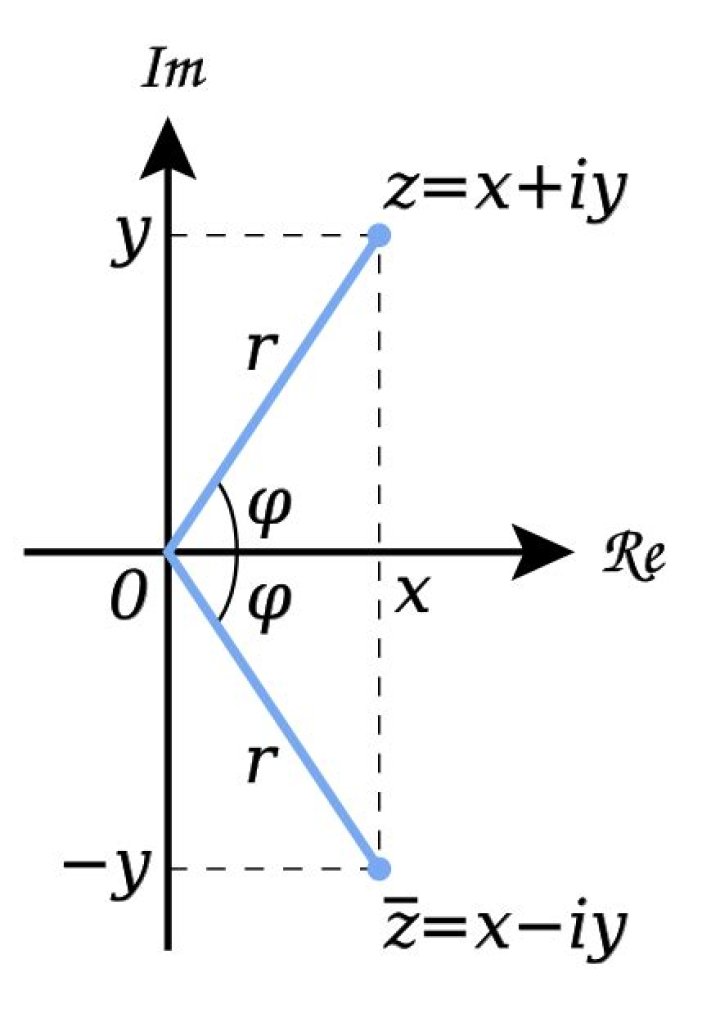
Geometrically, one can picture the complex conjugate as an automorphic map (meaning from $\Bbb C\to\Bbb C$) which reflects $z$ across the real axis. With this interpretation, it makes sense that real numbers (represented as coordinates on the complex plane with a $y$ value of zero) are precisely those that equal their conjugates.
$\endgroup$ 1 $\begingroup$If $z=a+bi$, by definition $$\overline z=a-bi$$
If $z=\overline z$, $$a+bi=a-bi\implies \color{RED}{b=0}$$
Graphically, considering $z$ as a vector on the complex plane, $\overline z$ is the reflection of $z$ along the real axis!
Brain exercise: what vectors would remain unchanged upon reflection along real axis?