What is $\dfrac{dr}{d\theta}$?
Suppose we have an equation of a polar curve with usual notation $r=f(\theta).$
I am curious about the geometric meaning of $$\dfrac{dr}{d\theta}=f'(\theta).$$ Also I would like to know the relations between $f'(\theta)$ and tangent at $(r, \theta).$
Thank you.
3 Answers
$\begingroup$This is just the rate of change of the radius with angle. For instance, if you describe a circle, you would expect this derivative to be zero, since the radius does not change with angle, and this is seen by $f(\theta) = R \Longrightarrow f'(\theta)=0$.
The tangent to the curve can be calculated as follows. The curve is given by: $$(x,y)= (r\cos \theta, r\sin \theta)=f(\theta)\cdot(\cos \theta, \sin \theta)$$ The slope of the tangent is defined by $m= dy/dx$, so: $$m=\frac{dy}{dx} = \left. \frac{dy}{d\theta}\middle/\frac{dx}{d\theta}\right.= \frac{f'(\theta)\sin\theta+f(\theta)\cos\theta}{f'(\theta)\cos\theta-f(\theta)\sin\theta}$$
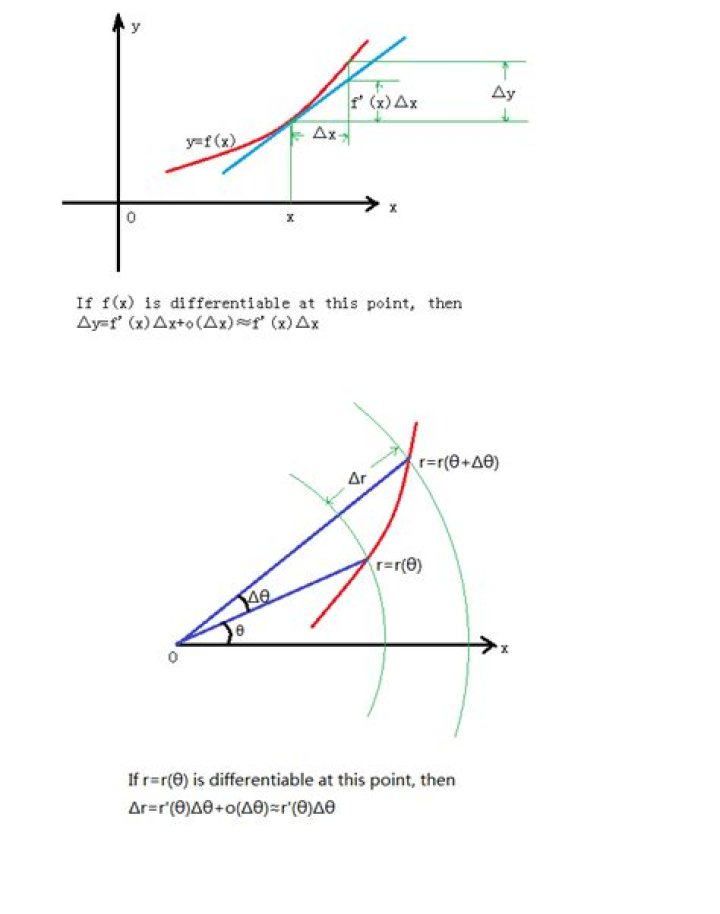
$\endgroup$ $\begingroup$A picture speaks louder than words:
EDIT assume that $\Delta x$ and $\Delta \theta$ are very close to $0$.
In addition, this picture intuitively explains why $\tan \gamma=\frac{r}{r'(\theta)}$ in @Narasimham's answer. (Can you see how?)
$\endgroup$ $\begingroup$If angle made by radial line to polar curve is $\gamma$ at any point, then
$$ \tan \gamma = \dfrac {r}{f^{'}(\theta)} $$
which can be regarded as a local "slope" for tangent to polar curve with respect to radial lines. For a radial it is zero and for circles centered at origin, $ \pi/2.$
EDIT1:
They are differential trig.relations. Consider the small differential triangle.
Opposite side is $r d\theta,$ adjacent side is $ dr,$ hypotenuse is $ ds.$ So,
$ \tan\gamma =\dfrac{rdθ}{dr} =\dfrac{r}{r'}; \sin \gamma =\dfrac{r}{s'};\cos \gamma =\dfrac{r'}{s'};\; $
Please note them down as they are very useful in setting up ODEs.
$\endgroup$ 3