what does " the absolute maximum value" mean?
The absolute maximum value of $f\left(x\right) = x^3-3x^2+12$ on closed interval $\left[-2,4\right]$ occurs at $x = $
Confused what does absolute maximum value means.
Does it mean
- The largest of the large values? $\max \{f\left(x\right)\mid x\in [-2,4]\}$
- The largest absolute value of $\max \{\vert f\left(x\right)\vert : x\in [-2,4]\}$
I have figured out that both values are the same when $x=4$, I can see that just from the graph of the function
2 Answers
$\begingroup$I would guess it is your first option. A usual terminology in calculus is about absolute and relative (or local) maxima and minima.
The absolute maximum would be then $\max\{f(x):\ x\in[-2,4]\}$.
The phrase "absolute maximum value" probably has to do with the fact that when looking at extrema of functions, one usually focus on where they are (i.e. $x=\ldots$) rather than what they are (i.e. $f(x)=\ldots$). The latter is the value, so saying "absolute maximum value" one wants the answer "$28$" as opposed "$x=4$".
$\endgroup$ $\begingroup$It means your first assumption.
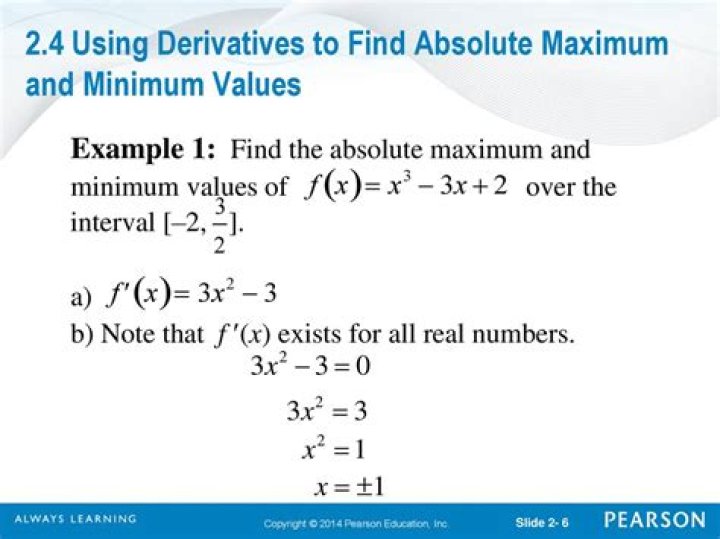
Setting the derivative equal to $0$, we obtain:
$3x^2 - 6x = 0 \Rightarrow$
$x(3x - 6)=0 \Rightarrow$
$x=0,$ or $x=2$
$f(2) = 8$, $f(0) = 12$
Now we test end points,
$f(4) = 64 - 48 + 12 = 28$
$f(-2)= -8 -12 + 12 = -8$
Hence $f(4)=28$ = $\max \{ f(x): x \in [-2,4]\}$
$\endgroup$ 2