What does it mean when standard deviation is higher than the variance?
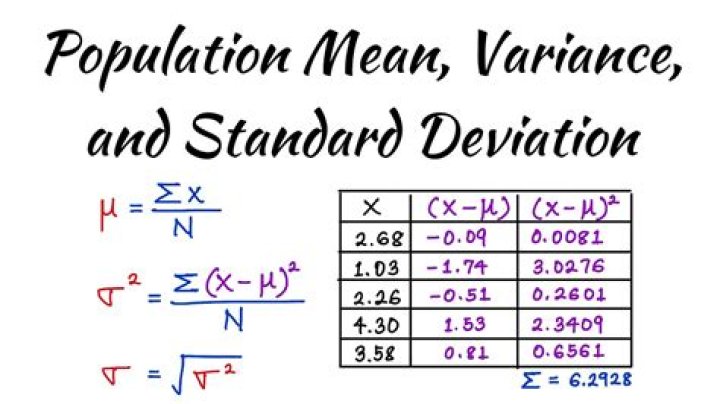
I am currently studying Wiener's process from Hull, and it says that the path of the process is jagged because when $\Delta t$ is small, the standard deviation i.e. $\sqrt{\Delta t}$ is bigger than $\Delta t$ which is the variance. I am trying to understand what this signifies.
$\endgroup$ 32 Answers
$\begingroup$Generally speaking, the standard deviation doesn't have the same units as the variance, so a simple comparison of two particular values doesn't mean anything. You might have a formalism that allows you to claim that $0.5\thinspace\mathrm m>0.25\thinspace\mathrm m^2$, but you're not going to get much insight from that inequality. On the contrary, it should leave you feeling a bit dirty.
What's more meaningful is to say that as $\Delta t$ approaches $0$, the standard deviation approaches $0$ more slowly than the variance does. That might be what Hull means; you'd have to unpack the context.
$\endgroup$ $\begingroup$The significance here is not that the standard deviation is greater than the variance. It is that the standard deviation goes to zero much slower than $\Delta t,$ (which happens to be the variance, but that fact is of little import, as far as I can tell).
This means that as you go down to small time scales, the absolute value of the derivative looks like $$ \frac{\Delta x}{\Delta t} \sim \frac{\sqrt{\Delta t}}{\Delta t} \sim \frac{1}{\sqrt{\Delta t}} \to \infty $$ so the derivative is very large and the path is very rough.
$\endgroup$ 1