What does it mean to solve a system of linear equations simultaneously?
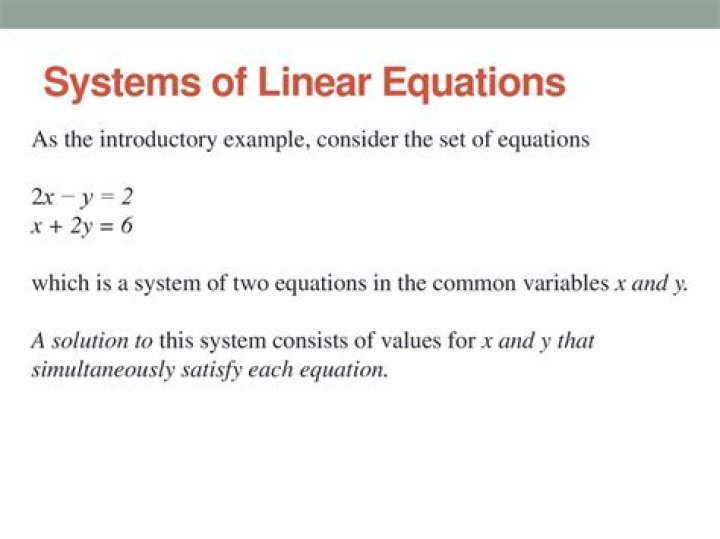
A system of linear equations is a finite collection of linear equations that is to be solved simultaneously. Does the phrase 'solving the system simultaneously' above mean you deal with the equations all together at once?
$\endgroup$ 33 Answers
$\begingroup$If I have the set of equations $$ \cases{x + y = 3\\x - y = 1} $$ then I can solve only the first equation, and I get solutions like $x = 5, y = -2$ or $x = 1003, y = -1000$. There are infinitely many solutions. I can also solve just the second equation and get solutions like $x = -5, y = -6$ or $x = 1000, y = 999$. Here, too, there are infinitely many solutions.
However, one could also try to find some value for $x$ and some value for $y$ which is a solution to the first equation, and at the same time (or "simultaneously", if you like) is a solution to the second equation. That is what that word means in this context, and most problems of this kind have exactly one such simultaneous solution.
$\endgroup$ $\begingroup$It means you're looking for a value for each of the unknowns such that all of the equations become true.
The term doesn't imply anything about how you find that combination -- though generally you would indeed work on all equations together.
$\endgroup$ $\begingroup$This definition is misleading.
IMO, it would be better to say: "A system of linear equations is a finite collection of linear equations that hold simultaneously", meaning that any solution must satisfy all the equations.
Then it is trivial that you need to handle them simultaneously while solving.
$\endgroup$ 1