What does internet that isn't dial-up sound like
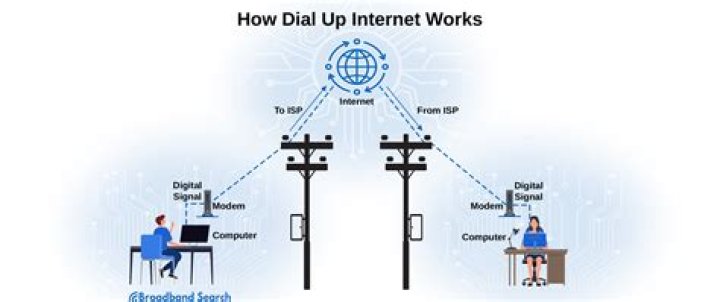
We've all heard the classic dial-up screeching sound, but what does it sound like for Cable/DSL/or fiber to be making a connection? I know old modems used to covert digital data to analogue before sending it over the phone line, and today DSL uses a complete other frequency thanks to micro-filters. I thought maybe it would just be silence since the human ear cannot hear above 20k herts?
If it can be heard, I would love a clip of it to listen to.
133 Answers
Analog modems use sound to encode data, but digital communications do not. Fiber uses light, and all the examples of what you want to hear are above 1 MHz, well above the level of human hearing.
1All signal is inherently analog when traversing its media. That's a fundamental of reality. This implies that any given signal could be placed in a media like air where vibrations propagate the signal. Since you don't care what he signal is, only whether any arbitrary signal (or multiplexed set thereof) could be audible, the idea of digitally encoded data or photon pulses don't really enter into it (and photons exhibit the properties of a wave, which is an innately analog phenomenon).
It is also the case that computers can encode and decode data via audio signals, which has applications in industrial systems malware and espionage.
It is my conclusion that just as we can visualize X-rays and other non-visible light spectrum, or topographically map earthquake vibrations, that we can also convert internet data transmissions to sound.
That said, as you rightly pointed out, humans have only so much bandwidth, and large portions of the signal would be undetectable to us, unless compressed and shifted into a range that meets our physical layer specifications.
It dosen't sound like anything. The oldschool modems were a workaround - In the US and some other countries, they used acoustic couplers which were restricted to 1200bps and were literally a device that fitted over your phone. Most proper standalone modems did not work that way. I'm assuming we're talking proper modems when talking about dialup. I for one have never seen an acoustic coupler, though we had a nice solid 1200bps modem with our XT which never saw the internet.
ADSL uses signals in frequencies not in use by phones, and in a purely digital format. Cable uses DOCSIS signalling, and once again, it isn't audio.
Fibre optic is light pulses. Can't hear it, they're probably too brief to see, tho there's a possibility of eye damage depending on intensity.
In all these cases, chances are the signal pulses are probably too short for a human to make out and in a format we can't 'hear'. They might also be compressed or otherwise processed.
For that matter, most of the dialup sound we've heard are the dialup 'handshake, as opposed to the actual data transmission'. Its meant to be heard. There's actually no useful information in it - its basically the two modems going 'can you hear me?', then adjusting for echos so you don't respond to your own hello, negotiating speeds then switching over to the actual data. Its specifically designed so if you got a call, and picked up a phone, you'd know you got a data transmission and would put it down. This is a pretty awesome writeup of the whole handshake process.
In short, you cannot hear the internet. Ever. What you can hear is two modems having a quick chat in a way engineers designed for you to be able to hear (and back in the day, a proper geek knew what his modem sounded like when things went well) . These sounds were intentionally meant to be human audible, and I suppose reassuring. I doubt actual data was ever human audible.
3