What does actually probability mean?
I am a beginner in quantum information. Reading about it has made me question the definition of probability.
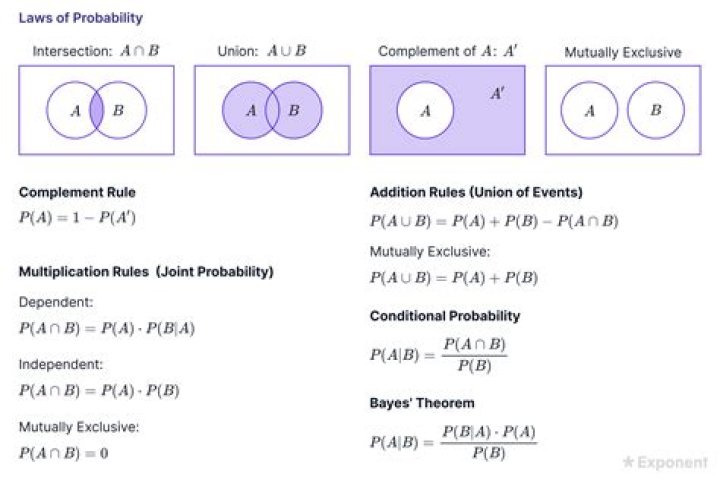
If the probability of an outcome $m$ in an experiment is $p(m)$ then it means that if I perform the experiment $n$ times ( $n \to \infty$ ) then $p(m)*n$ times I will get the outcome as $m$.
But probability of an outcome by intuition also means how certain we are that we will get that outcome as a result when we perform the experiment. But according to the first definition probability of an outcome makes sense when we perform the same experiment a very large number of times. Whereas according to the second definition we are just performing the experiment once and rather express probability as a measure of certainty.
sorry for asking a trivial question like this.
$\endgroup$3 Answers
$\begingroup$There are actually two competing notions of probability, Frequentist and Bayesian. Frequentist probability refers to the notion involving the frequency of a result in repeated trials; Bayesian probability is roughly a measure of our belief or confidence in an outcome occurring. Bayesian probability used to dominate, but Frequentist statistics is much more common today.
In the case of quantum mechanics, the Frequentist interpretation is considered the more natural one by most physicists: quantum mechanics is inherently non-deterministic, and the exact same experiment can produce different outcomes. Quantum mechanics only allows you to calculate the frequency of the various possible outcomes.
$\endgroup$ 7 $\begingroup$You dip your toe into the waters of controversy with such a question: the quoted definition is the frequentist definition of probability, the second one is called Bayesian, and an excellent way to cause a brawl among statisticians and probabilists is to ask them which they are: see Wikipedia's article for a long summary. There's plenty of other articles around the Internet that talk about this as well, but I thought that this question on Statistics StackExchange was a good explanation as well.
To put this in a physicist's context, it's about as controversial as the interpretation of quantum mechanics (except no statistician is crazy enough to suggest a many-worlds equivalent).
$\endgroup$ 3 $\begingroup$You need to distinguish between deterministic and probabilistic intuition here. If an experiment has outcome $\omega$ with probability $p$ of happening, that means that if we repeat this experiment $n$ times, we expect that $p \cdot n$ out of the $n$ experiments will have outcome $\omega$. This does not give us any control whatsoever on telling how many events will have outcome $\omega$, no matter how many times we repeat the experiment ($10, 100, 1000$, or even $10^{10^{10}}$ times). The expectation becomes a better approximation as we keep repeating the experiment, but it always remains an expectation and is never an actual prediction ; mathematics does not allow us to predict randomness, we can only understand its behavior.
For instance, flipping a (non-biased) coin gives us Heads with probability $1/2$. So if we flip one coin, it is of course false that we will get $0.5$ coins with Heads (since we cannot even flip such an amount of coins). So our expectation is inaccurate for sure, but it is the best expectation we have. If we flip a million coins however, we expect $500000$ coins heads, and in most cases (i.e. if we repeat the experiment "flipping a million coins" many times), $500000$ will be pretty close to the actual observation, making it a good candidate to estimate the number of heads we get.
Remark : a probability is not something intrinsic to the experiment ; WE decide how to assign probabilities. When we say a dice has probability $1/6$ to fall on each of its sides, it is something that we decided, and in practice we do indeed observe that this is a correct approximation. If our dice was biased, however, we might want to change those parameters to expect different results correctly.
Hope that helps,
$\endgroup$