What are the basic properties of a toroidal prism?
A triangular prism has a rectangular footprint and triangular roof. If the cross section is an equilateral triangle, and you know the footprint length x width, it is easy to calculate the rest such as wall lengths, wall area, and volume.
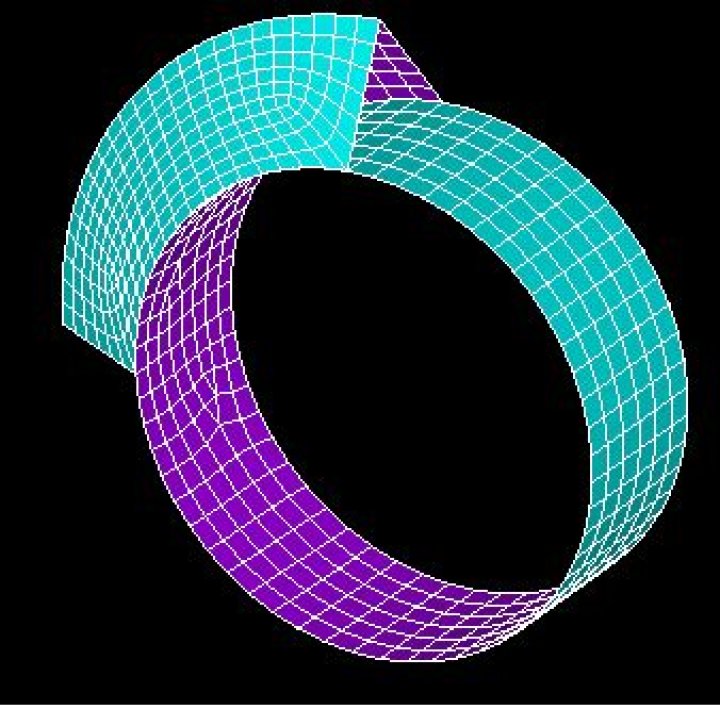
Now let's stretch and curve this prism into a loop. I call this a toroidal prism. It still has a cross section of an equilateral triangle, but now the walls are curved more like a cone.
I can't figure out what would be the formulas for area and volume. The flat base is easy enough, it's just bound by two concentric circles. But the walls are harder for me to fathom. What would be the formulas for this shape?
$\endgroup$ 12 Answers
$\begingroup$Recall Pappus' Centroid Theorem(s) for surfaces of revolution ...
$$\begin{align} \text{volume} &= (\text{distance traveled by centroid of region})\cdot(\text{area of region}) \tag{1a}\\ \text{surface area} &= (\text{distance traveled by centroid of arc})\cdot(\text{length of arc}) \tag{1b} \end{align}$$
Now, consider a "toroidal prism" generated by rotating an equilateral triangle about an axis. Conveniently, the center of the triangle serves as both the centroid of its triangular region and the centroid of its perimeter "arc". If the distance from the triangle's center to the axis is $r$, then $$\text{distance traveled by centroid (of region or arc)} = 2\pi r \tag{2}$$
If the triangle's side-length is $a$, then its area is $a^2\sqrt{3}/4$ and its "arc length" is $3a$, so that
$$\text{volume} = \frac{\pi a^2 r}{2}\sqrt{3} \tag{3a}$$ $$\text{surface area} = 6 \pi a r \tag{3b}$$
Note. In the description, "let's stretch and curve this prism into a loop" is a bit ambiguous. In the plane containing the axis of the torus and a cross-sectional triangle, the triangle could be oriented at any angle relative to the axis. As we see above, that doesn't matter. Volume and surface area are independent of this orientation.
$\endgroup$ $\begingroup$No matter how you rotate the triangular cross section around the center of the equilateral triangle before rotating on its toroid axis (to find area and volume) .. its area remains $ 6 \pi ar$ and volume $ \dfrac{\sqrt3 \pi a^2 r}{2}$ as given by Blue.
Thats the beauty of the Pappu's area/volume theorems, a portion of its swept area is shown. In addition, if the swept angle is one-third or one-fourth of $2 \pi$ full rotation around symmetry axis, area and volume need to be multiplied by that fraction.
Each wall of the triangular toroid has an area $ 2\pi a r $ for any cross sectional orientation change.
The foot print is no longer rectangular but is cylindrical.
$\endgroup$ 2