What's the difference between a cyclic and periodic function?
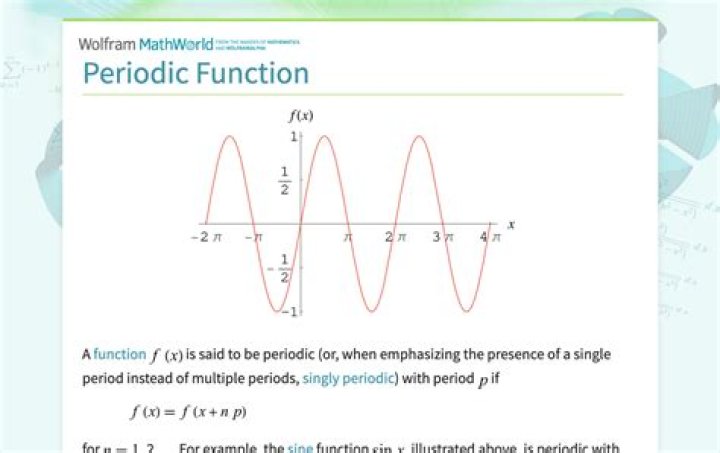
I've seen the words "cyclic" and "periodic" used to describe characteristics of a given function. What do they mean? I can't seem to find a difference. Wikipedia says a periodic function is one that repeats values in a periodic interval.
Maybe I was mistaking about the phrase "cyclic" being used to describe functions. One place I do see the word used in math is cyclic group.
$\endgroup$ 43 Answers
$\begingroup$A cyclic function might be referring to the iterates of a function (that is, when it's composed with itself multiple times). In particular, a function might be called cyclic if one of its iterates is the identity function. For example, every permutation of a finite set is a cyclic function according to this definition.
In particular, this is a completely different notion from a function being periodic, which discusses only the function itself (not its iterates) and how it behaves under translations of the domain.
$\endgroup$ $\begingroup$I would say that cyclic just means that it has certain range of independent values it can only use. For example, a Lagrangian becomes cyclic when you convert into polar coordinates. Essentially, the only values that are going to happen/actually have an effect on the dependent variable are [O,2pi] Therefore it is cyclic. I guess functions in polar coordinates in general might be an easy example of cyclic functions?
[This info on Lagrangians being cyclic in polar came from Thornton's Classical Dynamics 5th]
$\endgroup$ 1 $\begingroup$The difference between a cyclic and periodic function is that one is the inverse of the other.
Take $f=\sin(x)$, which is periodic. An inverse $f^{-1}$ is normally done after restricting the domain of $f$ so that it's one-to-one and $f^{-1}$ isn't multi-valued. This does not interest us.
If you don't restrict the domain, $f^{-1}$ becomes multi-valued and we call it cyclic.
And if you invert a cyclic function you get a periodic function.
$\endgroup$