What's the area of one arch of a cycloid?
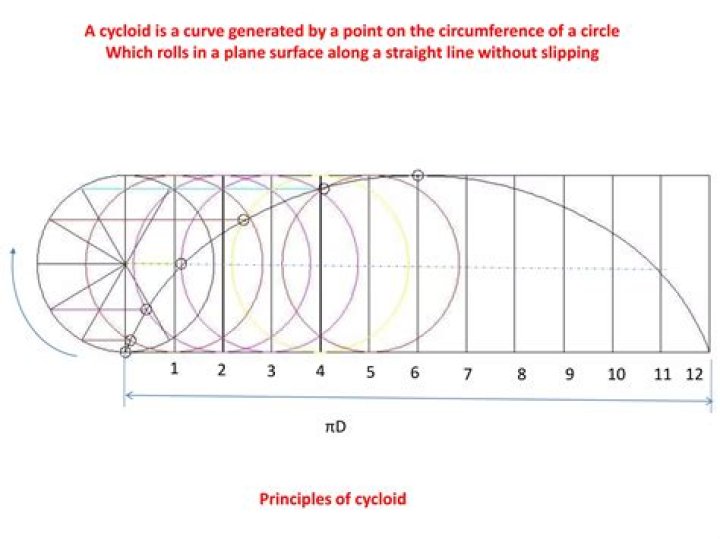
So, the cycloid is given with parametric equations: $$x=r(t-\sin{t})$$ $$y=r(1-\cos{t})$$ The teacher solved it like this: $$P=\int_a^by(x)dx$$ $x=x(t)$; $\alpha<t<\beta$ $$P=\int_\alpha^{\beta}y(t)x'(t)dt$$ $x'(t)=r(1-\cos{t})$ $$P=\int_0^{2\pi}r(1-\cos{t})r(1-\cos{t})dt=r^2\int_0^{2\pi}(1-2\cos{t}+\cos^2{t})dt=$$ $$=r^2(t|_0^{2\pi}-2\sin{t}|_o^{2\pi}+\frac{1}{2}t|_0^{2\pi}-\frac{1}{4}\sin{2t}|_0^{2\pi}=r^2(2\pi+\pi)=3r^2\pi$$ So, we get that the area below one arch of a cycloid equals three areas of a circle which forms that cycloid. My question is: I don't understand anything about this problem :) How did the teacher integrate this parametric equation, why did he write the integral of $y(t)x'(t)$, why did he need a derivative of x(t) and what does it represent. Can you please explain this to me geometrically?
$\endgroup$ 23 Answers
$\begingroup$This problem is a nice illustration of Green's theorem.
Let $R$ be the region enclosed by the piecewise defined curve $C= C_1 \cup C_2$, where $C_1$ and $C_2$ are defined as$$ \begin{align} C_1:x&=r(t-\sin{t}), ~~~y=r(1-\cos{t}), &0 \le t \le 2 \pi \\ C_2: x &= 2\pi (1-t) , ~~~~~y = 0, &0 \le t \le 1 \end{align}$$ Note that our curve $C$ is negatively (clockwise) oriented, and Green's Theorem requires positively oriented (counterclockwise) curves. We can denote the positively oriented 'reverse curve' by $ C^{*}$, where $C^{*} =-C$.
Green's Theorem states that for a simple closed positively oriented curve $C$, we have: $$\int_{C} (P\, dx + Q\, dy) = \iint_{R} \left(\frac{\partial Q}{\partial x} - \frac{\partial P}{\partial y}\right)\, dA $$ We can exploit Green's theorem to evaluate the area enclosed by the curve $C$ using the vector field $ \vec{\mathbf { F} } = \langle -y, 0 \rangle $. We get $$\int_C (-y ~dx + 0 ~dy) = \iint_R (0 - (-1)) dA =\iint_R dA $$ The latter integral is the area we want. Now using the fact that for any line integral and curve $\Gamma$ $$ \int_{-\Gamma} P dx + Q dy = - \int_{\Gamma} P dx + Q dy$$ we obtain $$ \iint_R dA = \int_{C^{*}} -y~ dx + 0~ dy =-\int_{C} -y ~dx + 0~ dy =\int_{C} y~ dx $$ Now we have a tangible result we can use. Evaluating the line integral we have $$ \begin{align} \int_{C} y~ dx &=\int_{C_1 \cup C_2} y~ dx \\ &= \int_{C_1} y~ dx + \int_{C_2} y~ dx \\ &= \int_{0}^{2\pi} (r (1-\cos t) ) ( r( 1- \cos t) ~dt) + \int_{0}^{1} 0 (-2 \pi dt ) \\ &= 3 \pi r^2 \end{align}$$
$\endgroup$ $\begingroup$Here is a picture of cycloid:
Do you know that the area under a curve $y(x)$ between an interval $[a,b]$ is
$$\int^b_a y(x) dx$$
By using change of variable $x=x(t)$, you can change the upper and lower limits to $0$ and $2\pi$, and $dx=x'(t)dt$. $y(x)$ then of course should be changed to $y(x(t))$ which is also $y(t)$.
$\endgroup$ 7 $\begingroup$For the integral of the parametric equation, he used one of the duplication formulae in trigonometry with an error (but he was lucky enough to get a correct final answer): $$1-2\cos t+\cos^2t=1-2\cos t+\frac{1+\cos 2t}2$$ hence the value of the integral is $$t-2\sin t+\frac t2 +\frac14\sin 2t\Biggr\lvert_0^{2\pi}= 3\pi.$$
As for the change of variable induced by the parametrisation of the cycloid, this comes from the very definition of the differential: $$\mathrm d\mkern1.5mu x=x'(t)\,\mathrm d\mkern1.5mu t.$$
$\endgroup$