Wanted : for more formulas to find the area of a triangle?
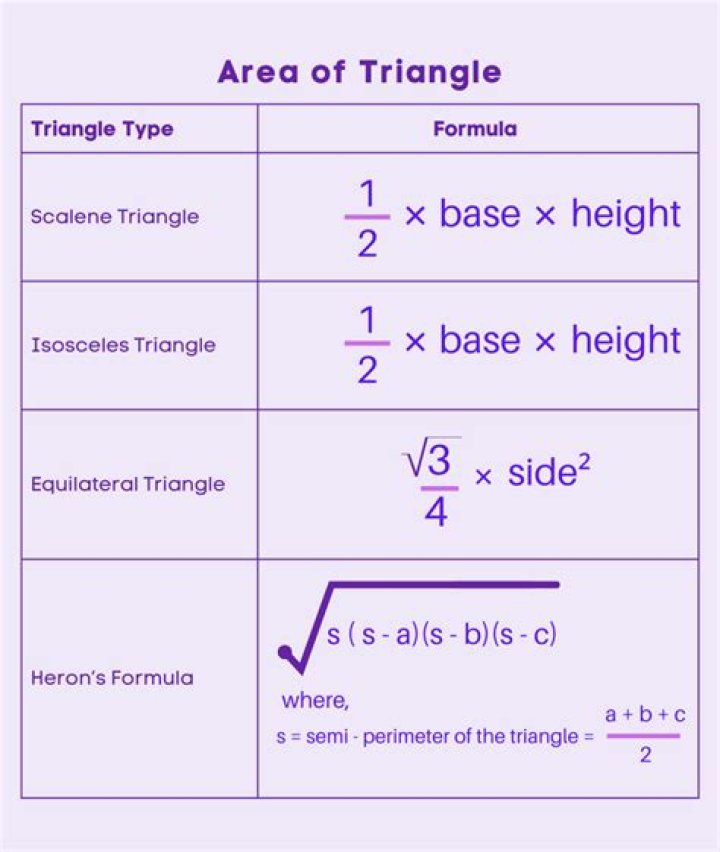
I know some formulas to find a triangle's area, like the ones below.
- Is there any reference containing most triangle area formulas?
- If you know more, please add them as an answer
$$s=\sqrt{p(p-a)(p-b)(p-c)} ,p=\frac{a+b+c}{2}\\s=\frac{h_a*a}{2}\\s=\frac{1}{2}bc\sin(A)\\s=2R^2\sin A \sin B \sin C$$
Another symmetrical form is given by :$$(4s)^2=\begin{bmatrix}
a^2 & b^2 & c^2
\end{bmatrix}\begin{bmatrix}
-1 & 1 & 1\\
1 & -1 & 1\\
1 & 1 & -1
\end{bmatrix} \begin{bmatrix}
a^2\\
b^2\\
c^2
\end{bmatrix}$$
Expressing the side lengths $a$, $b$ & $c$ in terms of the radii $a'$, $b'$ & $c'$ of the mutually tangent circles centered on the triangle's vertices (which define the Soddy circles)
$$a=b'+c'\\b=a'+c'\\c=a'+b'$$gives the paticularly pretty form $$s=\sqrt{a'b'c'(a'+b'+c')}$$
If the triangle is embedded in three dimensional space with the coordinates of the vertices given by $(x_i,y_i,z_i)$ then $$s=\frac{1}{2}\sqrt{\begin{vmatrix}
y_1 &z_1 &1 \\ y_2&z_2 &1 \\
y_3 &z_3 &1
\end{vmatrix}^2+\begin{vmatrix}
z_1 &x_1 &1 \\ z_2&x_2 &1 \\
z_3 &x_3 &1
\end{vmatrix}^2+\begin{vmatrix}
x_1 &y_1 &1 \\ x_2&y_2 &1 \\
x_3 &y_3 &1
\end{vmatrix}^2}$$
When we have 2-d coordinate $$ s=\frac{1}{2}\begin{vmatrix}
x_a &y_a &1 \\
x_b &y_b &1 \\
x_c &y_c & 1
\end{vmatrix}$$
In the above figure, let the circumcircle passing through a triangle's vertices have radius $R$, and denote the central angles from the first point to the second $q$, and to the third point by $p$ then the area of the triangle is given by: $$ s=2R^2|\sin(\frac{p}{2})\sin(\frac{q}{2})\sin(\frac{p-q}{2})|$$
$\endgroup$ 812 Answers
$\begingroup$Vectors: The area of a parallelogram embedded in a three-dimensional Euclidean space can be calculated using vectors. Let vectors $AB$ and $AC$ point respectively from $A$ to $B$ and from $A$ to $C$. The area of parallelogram ABDC is then $$\left|AB \times AC\right|$$ so that the area of a triangle is half of this, giving $$A_{\text{triangle}} = \frac{1}{2} |AB \times AC|.$$
Pick's Theorem: $$A_{\text{triangle}} = i + \frac{b}{2} - 1$$ where $i$ is the number of internal lattice points of a triangle and $b$ is the number of lattice points lying on the border of the triangle. As per mathlove: We require that all the triangle's vertices are on lattice points.
$\endgroup$ 7 $\begingroup$A two part paper by Marcus Baker (1849-1903) in vols. 1 and 2 of the Annals of Mathematics, readily available online, gives $110$ such formulae (warning: the Wikipedia article on triangles states that some of them are erroneous).
A collection of formulae for the area of a plane triangle] [Part 1], Annals of Mathematics (1) 1 #6 (January 1885), 134-138. JSTOR link google-books link archive.org link
A collection of formulae for the area of a plane triangle [Part 2], Annals of Mathematics (1) 2 #1 (September 1885), 11-18. JSTOR link google-books link archive.org link
Added as an edit since I can't comment. The links to these articles have been given above. While I'm at it, here is a systematic way to derive these formulae and even find your own new ones. Without loss of generality, one can assume that the vertices are $A=(0,0)$, $B=(1,0)$ and $C=(p,q)$. One can then spend a pleasant hour computing the metric quantities involved in the identities (side lengths, trigonometric functions of the angles, lengths of medians, angle bisectors, altitudes ....) in terms of $p$ and $q$. This reduces the problem to showing that an expression in these variables reduces to $\frac q 2$ or, after squaring, to $\frac{q^2} 4$. This can often be done by hand---in cases of emergency, one can use mathematica.
$\endgroup$ 3 $\begingroup$$s=pr$ where $p=\frac{a+b+c}{2}$ and $r$ is the radius of the inscribed circle.
$s=\sqrt{r\cdot r_a\cdot r_b\cdot r_c}$ where $r_a,r_b,r_c$ are the exradii of excircles.
I have a little more:) $$ S = 4R^2(\sin A + \sin B + \sin C)\sin\frac A2\sin\frac B2\sin\frac C2\\ S = \frac{r^2}{4}\frac{\sin A + \sin B + \sin C}{\sin\dfrac A2\sin\dfrac B2\sin\dfrac C2}\\ S = r^2\left(\cot\frac A2+\cot\frac B2 + \cot\frac C2\right)\\ S = r^2\cot\frac A2 \cot\frac B2 \cot\frac C2\\ S = 2p^2 \frac{\sin A\sin B\sin C}{(\sin A+\sin B+\sin C)^2}\\ S = 4p^2 \frac{\sin\dfrac A2 \sin\dfrac B2 \sin\dfrac C2}{\sin A+\sin B+\sin C} $$
$\endgroup$ 4 $\begingroup$If $W$ is the "hypotenuse-face" of a right-corner tetrahedron, and $X$, $Y$, $Z$ are the (right-triangular) "leg-faces", then
$$W^2 = X^2 + Y^2 + Z^2$$
where, yes, we are squaring areas. (This fact is actually equivalent to Heron's formula for non-obtuse triangles. You can extend it to include obtuse triangles by allowing the tetrahedron to have imaginary(!) edge-lengths at its right corner.)
More generally, if $W$, $X$, $Y$, $Z$ are the faces of a tetrahedron, and $\angle XY$ (etc) represents the dihedral angle between faces $X$ and $Y$, then we have a familiar-looking Law of Cosines:
$$W^2 = X^2 + Y^2 + Z^2 - 2 X Y \cos \angle XY - 2 Y Z \cos \angle YZ - 2 Z X \cos \angle ZX$$
(This is easily proven with vectors.) The above further implies another, more-familiar-looking Law:
$$\begin{align} W^2 + X^2 - 2 WX \cos\angle WX \;&=\; Y^2 + Z^2 - 2 YZ \cos\angle YZ \\ W^2 + Y^2 - 2 WY \cos\angle WY \;&=\; Z^2 + X^2 - 2 ZX \cos\angle ZX \\ W^2 + Z^2 - 2 WZ \cos\angle WZ \;&=\; X^2 + Y^2 - 2 XY \cos\angle XY \end{align}$$
(At the point where you say to yourself, "If there's any justice, each of these expressions should equal the square of the area of some face!", you will have inferred the existence of the tetrahedron's "pseudo-faces". But I digress ...)
$\endgroup$ $\begingroup$Using the law of sines, one can get
$$s=\frac{1}{2}bc \sin(\alpha)=\frac{1}{2}bc \frac{a}{2R}=\frac{abc}{4R}$$
where $R$ is the radius of the circumscribed circle.
$\endgroup$ 2 $\begingroup$Expressing the side lengths a,b & c in term of the radii a',b' & c' of the mutually tangent circles centered on the triangle vertices (which define the Soddy circles) $$a=b'+c'\\b=a'+c'\\c=a'+b'$$give the paticularly pretty form $$s=\sqrt{a'b'c'(a'+b'+c')}$$
$\endgroup$ 1 $\begingroup$$\require{cancel}$
Some errors spotted in Baker's papers, referenced inthe accepted answer.
Expression N20 is definitely wrong (even the dimension):
\begin{align} 20.\ & \cancel{\color{blue}{\frac{R\,r}{\beta_a\beta_b\beta_c}\, \left(\frac1a+\frac1b\right) \left(\frac1b+\frac1c\right) \left(\frac1c+\frac1a\right)}} , \end{align}
and most likely, the term $\beta_a\beta_b\beta_c$must be in the numerator and a constant $\tfrac12$ is missing, so the correct form should be
\begin{align} 20.\ & \tfrac12\,{R\,r}{\beta_a\beta_b\beta_c}\, \left(\frac1a+\frac1b\right) \left(\frac1b+\frac1c\right) \left(\frac1c+\frac1a\right) . \end{align}
In the second Baker's paper, expressions N63, N80 are wrong :
\begin{align} 63.\ & \cancel{\color{blue}{R^2\sin 2A (1+\cos C)}} \end{align}
\begin{align} 80.\ & \cancel{\color{blue}{a\,(-\beta_a\,\sin \tfrac12\,A+\beta_b\,\sin \tfrac12\,B+\beta_c\,\sin \tfrac12\,C)}} \\ \quad&= \cancel{\color{blue}{2\,s\,(\beta_a\,\sin \tfrac12\,A+\beta_b\,\sin \tfrac12\,B+\beta_c\,\sin \tfrac12\,C)}} . \end{align}
Also, in N94 the two first expressions are correct:\begin{align} 94.\ & r^2\cot\tfrac12\,A+2\,R\,r\,\sin A \\ &= r_a^2\cot\tfrac12\,A-2\,R\,r_a\,\sin A , \end{align}but there are obvious typos in the third and fourth. They should be
\begin{align} &=r_b^2\cot\tfrac12\,B-2\,R\,r_b\,\sin B \\ &=r_c^2\cot\tfrac12\,C-2\,R\,r_c\,\sin C . \end{align}
$\endgroup$ $\begingroup$I have an expression in terms of dot products of the edges. It works for triangles in any spatial dimension. It only uses dot-products for computation, so is very efficient for use on a computer. It is also quite aesthetically pleasing for its symmetry. No absolute value taken.$$ \begin{split} e_0 &= v_2 - v_1\\ e_1 &= v_0 - v_2\\ e_2 &= v_1 - v_0\\ A &= \frac{1}{2} \sqrt{e_0^T e_1 \cdot e_1^Te_2 + e_1^T e_2 \cdot e_2^Te_0 + e_2^T e_0 \cdot e_0^Te_1} \end{split} $$See meshplex.
The formula can, for example, be derived from the Gram-determinant representation (see ).
$\endgroup$ 2 $\begingroup$Incircle bisectors $d_a,d_b,d_c$, mentioned inincircle-bisectors-and-related-measuresalong with the radii of corresponding incircles $r,r_a,r_b,r_c$provide a whole lot of expressions for the area $S$ of $\triangle ABC$.
Recall that cevian $AD_a$splits the triangle $ABC$ into a pair of triangles$T_1=\triangle ABD_a$,$T_2=\triangle AD_aC$ (assuming that $A,B,C$ are in counterclockwise order), such that the radii of their incircles are the same,$r_{a1}=r_{a2}=r_a$.
Similar conditions hold for cevians $BD_b$ and $CD_c$.
Given that $a,b,c$ are the sides of $\triangle ABC$,$r$ is the radius of its inscribed circle and $\rho=\tfrac12(a+b+c)$,\begin{align} |AD_a|=d_a&=\sqrt{\rho(\rho-a)} ,\\ r_a&=\frac{r}{1+\sqrt{1-\frac a\rho}} ,\\ l_a&=\frac1{r_a} \end{align}
together with similarly defined$d_b,d_c,r_b,r_c,l_b,l_c$, expressions for the area follows:
\begin{align} S&= \frac{d_a d_b d_c}{\sqrt{d_a^2+d_b^2+d_c^2}} \tag{1}\label{1} ,\\ &= \frac{a r_a^2}{2r_a-r} \tag{2}\label{2} ,\\ &= (d_a^2+d_b^2+d_c^2)(\tfrac r{r_a}-1)(\tfrac r{r_b}-1)(\tfrac r{r_c}-1) \tag{3}\label{3} ,\\ &= r_a\,\Big(d_a+\sqrt{d_a^2+d_b^2+d_c^2}\Big) \tag{4}\label{4} ,\\ &= \frac{r^2\,r_a\,r_b\,r_c}{(r-r_a)(r-r_b)(r-r_c)} \tag{5}\label{5} . \end{align}
Note, that \eqref{5} can be expressed in terms of just the three radii $r_a,r_b,r_c$since we can express $r$ as\begin{align}
r&=
\frac{l_a+l_b+l_c+\sqrt{2\,(l_a l_b+l_b l_c+l_c l_a)-(l_a^2+l_b^2+l_c^2)}}{l_a^2+l_b^2+l_c^2}
\tag{6}\label{6}
\end{align}
and \eqref{5} becomes\begin{align}
S&=
\frac{(l_a^2+l_b^2+l_c^2)\,(l_a+l_b+l_c+\sigma)^2}
{(l_a\,(l_b+l_c+\sigma)-l_b^2-l_c^2)\,(l_b\,(l_c+l_a+\sigma)-l_c^2-l_a^2)\,(l_c\,(l_a+l_b+\sigma)-l_a^2-l_b^2)}
\tag{7}\label{7}
,
\end{align}where\begin{align}
\sigma&=
\sqrt{2\,l_a\,l_b+2\,l_b\,l_c+2\,l_c\,l_a-l_a^2-l_b^2-l_c^2}
\tag{8}\label{8}
.
\end{align}
Edit
An interesting equation for $S$also exists for the case of uneven bisection, that is, when the corresponding pairs of inscribed circles have different radii,\begin{align} r_{a1}&\ne r_{a2},\quad r_{b1}\ne r_{b2},\quad r_{c1}\ne r_{c2} ,\\ l_{a1}&=1/r_{a1},\quad l_{a2}=1/r_{a2} ,\\ l_{b1}&=1/r_{b1},\quad l_{b2}=1/r_{b2} ,\\ l_{c1}&=1/r_{c1},\quad l_{c2}=1/r_{c2} . \end{align}
In this case we have
\begin{align} S&= r^2\,\sqrt{\frac{r_{a1}r_{a2}r_{b1}r_{b2}r_{c1}r_{c2}}{(r-r_{a1})(r-r_{a2})(r-r_{b1})(r-r_{b2})(r-r_{c1})(r-r_{c2})}} ,\\ r&= \frac{l_{a1}+l_{a2}+l_{b1}+l_{b2}+l_{c1}+l_{c2}}{2 (l_{a1} l_{a2}+l_{b1} l_{b2}+l_{c1} l_{c2})} \\ &+ \frac{\sqrt{(l_{a1}+l_{a2}+l_{b1}+l_{b2}+l_{c1}+l_{c2})^2-8 (l_{a1} l_{a2}+l_{b1} l_{b2}+l_{c1} l_{c2})}} {2 (l_{a1} l_{a2}+l_{b1} l_{b2}+l_{c1} l_{c2})} . \end{align}
$\endgroup$ $\begingroup$Consider $\triangle ABC$ and inscribed circle with radius $r$. Three smaller similar triangles$\triangle AcBcC,\ \triangle AbBCb,\ \triangle ABaCa$are cut by tangent lines to the incircle parallel to the corresponding sides of $\triangle ABC$.
Given the radii $r_a,\ r_b,\ r_c$ of the incircles of$\triangle ABaCa,\ \triangle AbBCb,\ \triangle AcBcC$, respectively, the area of $\triangle ABC$ is found as
\begin{align} \bbox[5px,border:2px solid #C0A000]{ S= \sqrt{\frac{(r_a+r_b+r_c)^7}{r_a\,r_b\,r_c}} } \tag{1} . \end{align}
Also, inradius $r$, semiperimeter $\rho$, and circumradius $R$of $\triangle ABC$ can be found as
\begin{align} r&=r_a+r_b+r_c \tag{2} ,\\ \rho&= \sqrt{\frac{(r_a+r_b+r_c)^5}{r_a\,r_b\,r_c}} \tag{3} ,\\ R&= \tfrac14\,\frac{r(r-r_a)(r-r_b)(r-r_c)}{r_a r_b r_c} \\ &= \tfrac14\,\frac{(r_a+r_b+r_c)(r_a+r_b)(r_b+r_c)(r_c+r_a)}{r_a r_b r_c} \tag{4} . \end{align}
And the side lengths of $\triangle ABC$ can be found explicitly as
\begin{align} a&=r\,(r_b+r_c)\,\sqrt{\frac{r}{r_a\,r_b\,r_c}} ,\\ b&=r\,(r_c+r_a)\,\sqrt{\frac{r}{r_a\,r_b\,r_c}} ,\\ c&=r\,(r_a+r_b)\,\sqrt{\frac{r}{r_a\,r_b\,r_c}} . \end{align}
$\endgroup$ $\begingroup$Two more expressions, similar to Heron’s formula for the area of $\triangle ABC$.
Let cevians $AD,AE,BF,BG,CK,CL$be such that (see name-for-the-pair-of-constrained-triples-of-ceviansfor more info)\begin{align} |BD|&=|CE|=ka ,\quad |CF|=|AG|=kb ,\quad |AK|=|BL|=kc \tag{1} \end{align}
for some $k\in\mathbb{R}$, and let\begin{align} |AD|&=d_{a1} ,\quad |BF|=d_{b1} ,\quad |CK|=d_{c1} \tag{2} ,\\ |AE|&=d_{a2} ,\quad |BG|=d_{b2} ,\quad |CL|=d_{c2} \tag{3} ,\\ \delta_1&=\tfrac12\,(d_{a1}+d_{b1}+d_{c1}) \tag{4} ,\\ \delta_2&=\tfrac12\,(d_{a2}+d_{b2}+d_{c2}) \tag{5} . \end{align}
Then for any $k\in\mathbb{R}$
\begin{align} S_{ABC}&= \frac{\sqrt{\delta_1(\delta_1-d_{a1})(\delta_1-d_{b1})(\delta_1-d_{c1})}}{k^2-k+1} \tag{6} ,\\ &= \frac{\sqrt{\delta_2(\delta_2-d_{a2})(\delta_2-d_{b2})(\delta_2-d_{c2})}}{k^2-k+1} \tag{7} . \end{align}
In fact, expressions (6)-(7) also include the famous Heron’s formula as a special case when either $k=0$ of $k=1$, and the triplet of cevians becomes a triplet of the sides $a,b,c$.
$\endgroup$ 1