Use of vinculum to indicate a group of variables represents digits of a number
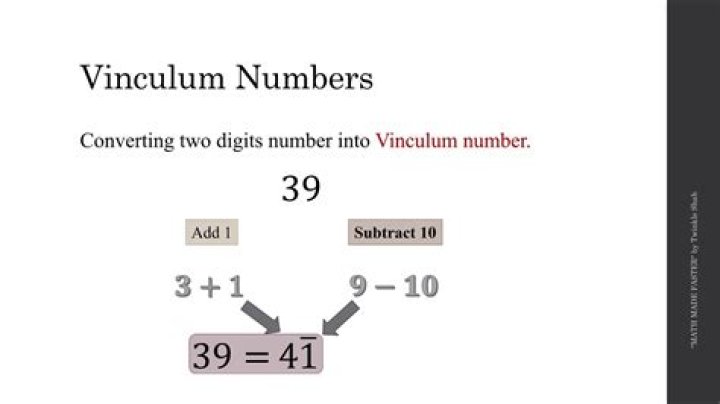
In my country, there's a long-standing tradition of using the vinculum in contexts similar to this:
Let $\overline{ab}$ be a two-digit natural number. Show that ...
I have only happened once to come across an explanation for this notation in a textbook. It stated that the "bar" (more technically, the vinculum) above a group of variables serves to distinguish digit representation of a number from multiplication $a\cdot b$.
However, I have never seen the vinculum being used in this way in English mathematics literature, its uses being restricted to:
- part of the radical symbol $\surd$, e.g. $\sqrt{a^2+b^2}$
- repeating decimals, e.g. $0.\overline{75}=0.757575\ldots$
- complex conjugate, e.g. if $z=a+\text{i}b$, then $\overline{z}=a-\text{i}b$
- negation of a logical expression, e.g. $\overline{A\lor B}$
- line segment $\overline{AB}$ between points $A$ and $B$
- fractions and division in general (seems dubious to me), e.g. $\dfrac{a}{b},\ \ \dfrac{7+5}{3+1}$
Has anyone else seen the vinculum being used for grouping the digits of a number? Perhaps the vinculum has other uses outside of English-speaking countries?
$\endgroup$ 2 Reset to default