U substitution. What do the dx and du represent?
I'm reading my textbook and I came across this problem:
The above makes sense to me except for one line:
$$-ln|\cos{x}| = ln|\cos{x}|^{-1}$$
Why is this?
I plugged in $\frac{\pi}{3}$ and it works, but I'm not sure why.
Also, in the above question, what do the du and dx represent? When we write $du = -\sin{x} \cdot dx$, what are we really saying?
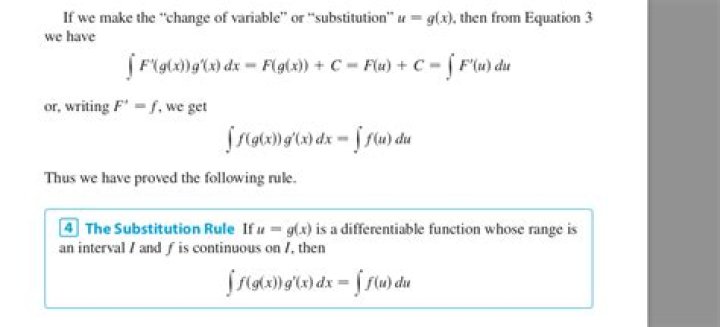
Like in this explanation for substitution rule, what does the $du$ represent?
4 Answers
$\begingroup$For your first question, we use the properties of logarithms: $\ln(y^a)=a\ln y$. Now let $y=|\cos x|$, and $a=-1$ to get $$-\ln|\cos x|=\ln\left(|\cos x|^{-1}\right)$$
For your second question, when we write $du=-\sin x \,dx$, what we are really saying is $\frac{du}{dx}=-\sin x$. Then we make a substitution into the integral. $$\int f(x)\,dx=\int f(x(u))\,\frac{dx}{du}\,du$$So if we instead just replace $dx$ by $\frac{du}{\left(\frac{du}{dx}\right)}$ in the integrand, then we have not changed anything about the integral, other than the fact that it is now taken with respect to $u$. So in your example, we replace $dx$ with $\frac{du}{-\sin x}$.
Really, '$du=-\sin x\,dx$' doesn't mean anything mathematically. It is just one of the advantages of using the fractional notation we use for derivatives, that "multiplying across" the $dx$ works.
$\endgroup$ 4 $\begingroup$Note that $$\ln\left(\frac{1}{a}\right)=\ln(1)-\ln(a)=0-\ln(a)$$ for $a>0$
$\endgroup$ 1 $\begingroup$Really two questions here.
The first is a property of the logarithm:
$$\ln (1/x) = \ln (x^{-1}) = (-1) \cdot \ln x = - \ln x.$$
For the second, you're doing a substitution:
$$u = \cos(x)$$
By the chain rule,
$$du = -\sin(x) dx$$
Now you have expressions to substitute:
$$\frac{\sin(x)}{\cos(x)}dx = \frac{1}{\cos(x)}\sin(x)dx = \frac{1}{u}(-du).$$
$\endgroup$ 2 $\begingroup$For your first question as to why $\ln(\cos(x))^{-1} = \ln(\sec(x))$ is because $\cos(x)=\frac{1}{\sec(x)}$. In genral $a(\log_b(c))=\log_b(c^a)$
As for your second question asking the use of $du $ and $dx$ is that you are changing variables from $x$ to $u$.So you need to change the variable wrt to which you are integrating.
Eg $\int\frac{\ln(x)}x\,dx$
here we let $u=\ln(x)$
differentiate wrt $x$ both sides
We get , $du = \frac1xdx\implies dx= xdu$
$\int \frac{\ln(x)}x\,dx = \int\frac{u}{x}\,x\,du = \int u\,du = \frac{u^2}{2}+C =\frac{\ln^2(x)}2+C$
$\endgroup$