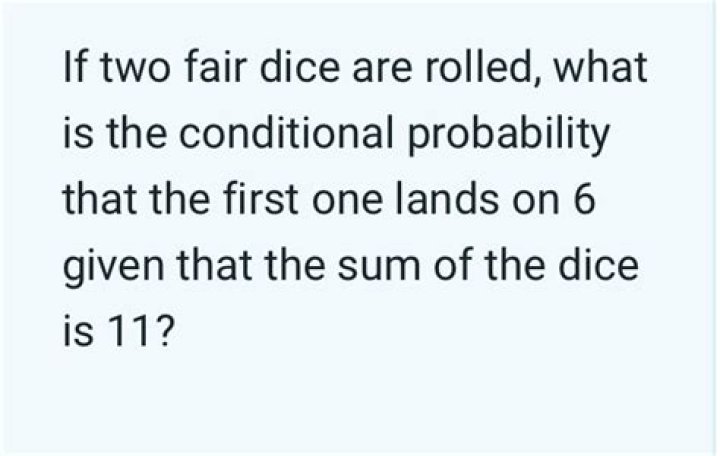
Two fair dice are rolled. What is the conditional probability that at least one lands on 6 given that the dice land on different numbers?
$F =$ The probability that the dice land on different numbers
$F = {(1,2),(1,3),(1,4),(1,5),(1,6),(2,1),(2,3),(2,4),(2,5),(2,6),(3,1),(3,2),(3,4),(3,5),(3,6),(4,1),(4,2),(4,3),(4,5),(4,6),(5,1),(5,2),(5,3),(5,4),(5,6),(6,1),(6,2),(6,3),(6,4),(6,5)}$
$F = \frac{30}{36} = \frac{5}{6}$
$E =$ The event that at least one lands on 6
$E = {(1,6),(2,6),(3,6),(4,6),(5,6),(6,1),(6,2),(6,3),(6,4),(6,5),(6,6)}$
$E = \frac{11}{36}$
What is the probability of E, when given that F has occurred?
$P = \frac{P(EF)}{P(F)}$
$P = \frac{1-P(EF^c)}{P(F)}$
$P = \frac{\frac{11}{36}}{\frac{5}{6}}$
$P = \frac{11}{30}$
This answer was incorrect it is $\frac{1}{3}$ I think there is an issue in identifying $P(EF)$, what should that be and why? Identifying F is easy because that is what is given to have occurred.
Added: Is $EF$ equivalent to $E \cap F$?
$\endgroup$ 34 Answers
$\begingroup$The mistake in your work is that while the question asks us to find that the numbers on the dice are different, in writing the sample space for event $E $, you have also included $(6,6) $ where the numbers are not different. Correct that and we will get, $$P=\frac{\frac{10}{36}}{\frac {5}{6}} =\frac {1}{3} $$ Hope it helps.
$\endgroup$ $\begingroup$$S:$ The sample space consists of six times six outcomes. $$\lvert S\rvert = 36$$
$F:$ The event that the die land on different numbers. The same numbers occur on both die in six of all the above outcomes. So excluding these inadmissible outcomes leads to: $$\lvert F\rvert = 30$$
$E:$ The event that at least one die lands on a six. There are six outcomes where one die lands on a six, six where the other does, and we must not double count the one outcome where both do so. $$\lvert E\rvert = 11$$
$EF:$ The event that at least one die lands on a six and the other die is a different number. Clearly of the above, the outcome of both die land up six must be excluded.
$$\lvert EF\rvert = 10$$
Everything else is just substitution.
$\endgroup$ $\begingroup$There are only 10 cases where the dice have different numbers: (1, 6), (2, 6), ..., (5, 6), (6, 5), (6, 4), ..., (6, 1).
So the answer is then $\frac{\frac{10}{36}}{\frac{5}{6}}=\frac{1}{3}$.
$\endgroup$ $\begingroup$You have made a mistake. In event E, $(6,6)$ is not an option, since it is given that dices are to land on different numbers. So you have only 10 such. So the probability is, going by your method, ${10\over{36}}\over{5\over6}$
This is $1\over3$.
$\endgroup$