Trisecting an angle
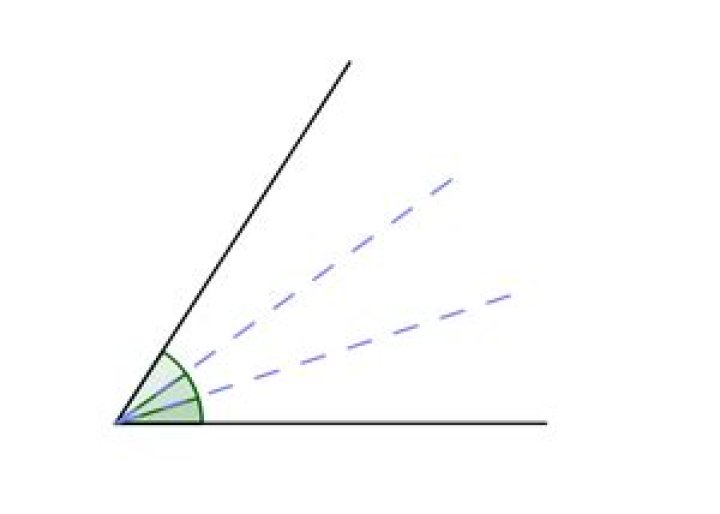
In this Numberphile video it is stated that trisecting an angle is not possible with only a compass and a straight edge. Here's a way I came up with:
Let the top line be A and bottom line be B, and the point intersecting P.
1. Use the compass and pick any length. Draw a point M n units from P on A. Use the compass again to draw a point N n units from P on B.
2. Connect M and N.
3. Since we know how to trisect a line, we can trisect it and get 3 equal distance line segments with 2 points in between.
4. Connect the 2 points to the point P.
5. Done.
This seems to work for all angles that are not 0 or 180 degrees. Given that it is proven that it's not possible to trisect an angle with only compass and a ruler without marks, something must have been wrong in my steps but I can't see any. Where is my mistake?
$\endgroup$ 13 Answers
$\begingroup$Let $X$ and $Y$ be the two points you added to $\overline{MN}$, as shown.
Consider $\triangle PMY$. Assuming your trisection construction to be valid, $\overline{PX}$ must bisect $\angle MPY$. By the Angle Bisector Theorem, we have $$\frac{|\overline{PM}|}{|\overline{PY}|} = \frac{|\overline{XM}|}{|\overline{XY}|} = 1$$ so that $\overline{PM}\cong\overline{PY}$. By the same logic, $\overline{PN}\cong\overline{PX}$. Thus, $M$, $N$, $X$, $Y$ are all equidistant from $P$.
See the problem?
$\endgroup$ 4 $\begingroup$If $\angle APB= \alpha$, then middle angle (middle part) will have measure $$ \beta = 2\arctan \left(\frac{\tan(\alpha/2)}{3}\right) {\Large\color{red}{\ne}} \dfrac{\alpha}{3}. $$
A few examples: \begin{array}{|c|c|c|} \hline \alpha & \beta & error\\ \hline 3^\circ & 1.000203^\circ & 0.0203\%\\ 6^\circ & 2.001626^\circ & 0.0813\%\\ 9^\circ & 3.005494^\circ &0.183\%\\ \hline 30^\circ & 10.207818^\circ & 2.078\%\\ 60^\circ & 21.786789^\circ & 8.933\%\\ 90^\circ & 36.869897^\circ & 22.899\%\\ \hline \end{array}
When angles are small, then this method gives not bad approximation, but it isn't the exact way of trisection.
$\endgroup$ 1 $\begingroup$Let your angle be almost 180 degrees, so your two lines are almost coincident. The line $MN$ is also almost parallel to the lines, and trisecting that segment leads to very unequal "thirds" of the angle.
$\endgroup$ 7