Transformation of homogeneous coordinates to Euclidean coordinates?
I understand that two vectors
$$ v_{1} = \begin{pmatrix} x \\ y \\ z \end{pmatrix} \quad \text{,} \quad v_{2} = \begin{pmatrix} x' \\ y' \\ z' \end{pmatrix} $$
in homogeneous coordinates are equivalent if
$$ \begin{pmatrix} x \\ y \\ z \end{pmatrix} = \lambda \begin{pmatrix} x' \\ y' \\ z' \end{pmatrix} \quad,\quad \lambda \neq 0. $$
I visualize these equivalence classes as "rays" from the coordinate system origin (with the origin itself excluded).
To convert a vector from homogeneous to Euclidean coordinates, one divides all components by a number such that $z\rightarrow 1$. Example:
$$ \begin{pmatrix} 0 \\ 8 \\ 4 \end{pmatrix}_\text{hom} \quad \rightarrow \quad \begin{pmatrix} 0 \\ 4 \\ 1 \end{pmatrix}_\text{eucl} $$
Question: What is the correct transformation of $v = \begin{pmatrix} 1 \\ 0 \\ 0 \end{pmatrix}_\text{hom}$ to Euclidean coordinates?
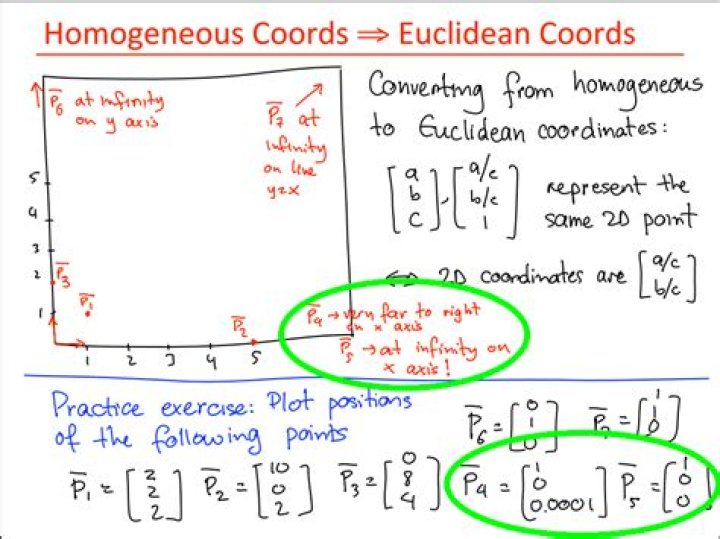
UPDATE - I'm adding the source for this question. This is the slide in question:
Take a look at how $P _{4} \,$ and $P _{5} \,$ are transformed:
$$ P_{4, \,hom} = \begin{pmatrix} 1 \\ 0 \\ 0.0001 \end{pmatrix} \quad \rightarrow \quad P_{4, \,eucl} = \begin{pmatrix} 10000 \\ 0 \\ 1 \end{pmatrix} $$
$$ P_{5, \,hom} = \begin{pmatrix} 1 \\ 0 \\ 0 \end{pmatrix} \quad \rightarrow \quad \text{"at infinity} \,\textbf{on x-axis}" $$
$\endgroup$ 31 Answer
$\begingroup$$v$ is a point at infinity. There is no equivalent point in euclidean space, but you can think it as the point of intersection of the lines of a parallel bundle.
$\endgroup$ 5