There is a prime number between $90$ and $100$.
- There is a prime number between $90$ and $100$.
How can I show this? I couldn't use Bertrand's Postulate because it says that if $n>1$ then, then there is always at least one prime $p$ such that $n<p<2n$.
$\endgroup$ 104 Answers
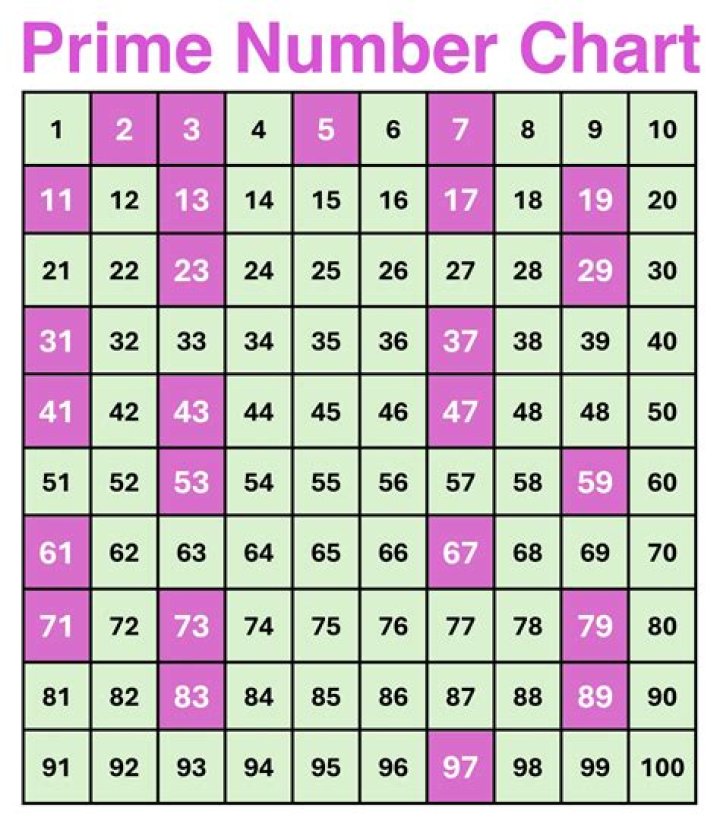
$\begingroup$The numbers between 90 and 100 are$$ 91,92,93,94,95,96,97,98,99 $$There's only 9 of them, so you can just check each by hand. All but 91 and 97 are obviously divisble by 2, 3, or 5, and thus are not prime. Are either of 91 and 97 prime?
$\endgroup$ 2 $\begingroup$Sometimes in math proving a statement only requires you find a single example. Since they are only asking to show that there is a prime number between 90 and 100 it's enough to list one of those prime numbers such as 97. If you really wanted to go the extra mile do not assume that whoever is asking for this proof already knows that the number you give is in fact prime (even though realistically they would just know that). You can do so by showing that your number doesn't have any prime factors between 1 and 50.
$\endgroup$ 3 $\begingroup$If you're only given nine integers $\in\{i\in\Bbb N:91\le i\le99\}$ to be taken into consideration, then looking for an example might be the easiest way to approach the problem. In this case, using the Sieve of Eratosthenes, you can check that all integers of the set except $97$ are divisible by either $2,3,5$ or $7$. It's then easy to prove that $97$ is prime.
Now -of course- if you had to prove another statement regarding all positive integers up to $10^9$, looking for an example might be rather tedious. Here, you might prefer to look for a more general proof that confirms the statement without necessarily generating an example...
In this case, you might want to consider this approach (where I will prove that there is a prime number between $29$ and $40$ exclusive since it doesn't work for your example).
Lemma 1 $\;$ If a positive integer $n\gt1$ is composite (i.e. not prime), then there is at least one divisor $a\gt 1$ of $n$ such that $a\le\sqrt{n}$
Proof: From the definition of composite positive integers, suppose $\exists b=a+\epsilon\ge a$ such that $$a\cdot b=a\cdot(a+\epsilon)=n\iff a=\frac{n}a-\epsilon \le \frac na\implies a^2\le n\implies a\le\sqrt n$$
Lemma 2 $\;$ Among any ten consecutive positive integers, there's always at least one being coprime to the $9$ integers left.
Proof: See here.
So what does this tell us? From the second lemma, we deduce that in the set $N=\{30, 31 , 32, ..., 38, 39\}$ there exists at least one element $k\in N$ being coprime to the prime factors $2, 3, 5$.
However, wait a second, in virtue of the first lemma, every composite integer in $N$ is divisible by a positive integer $a\le \sqrt {39}<7$. Thus, in order $k$ to be composite, it should be divisible by at least one of the primer numbers $2,3,5$, but we have proven this isn't the case. Hence, $k$ is prime.
This is precisely the reason why I find mathematics so interesting: You often don't even have to find an example satisfying certain conditions, it suffices to show that such a number exists!
$\endgroup$ $\begingroup$Another sieve is Sieve of Sundaram
it only cares about odd primes (aka not 2), but uses they can't have form $$(2k+1)(2j+1)=4kj+2j+2k+1=2(2ij+i+j)+1,\quad i,j>0$$ so we are looking for ones that can't fit this. $$91=2(2(3)(6)+3+6)+1=2(45)+1\\93=2(2(1)(15)+1+15)+1=2(46)+1\\95=2(2(2)(9)+2+9)+1=2(47)+1\\97=?\\99=2(2(4)(5)+4+5)+1=2(49)+1$$
and 97 doesn't have one, meeting the criterion.
$\endgroup$