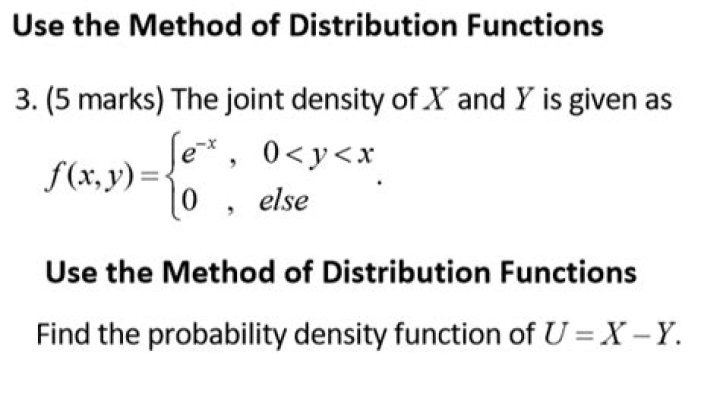
The Method of Distribution Functions
Let $Y$ be a random with the following probability density :
$$ f_Y(y) = \begin{cases} 2y, & 0 \leq y \leq 1 \\ 0, & \text{elsewhere} \end{cases} $$
Let $U = 3Y -1$. I want to find the density function $f_U(u)$. I know I can find it using the Method of Distribution Functions namely by finding $F_U(u) = P(U \leq u) = P(Y \leq \frac{u+1}{3})$ and then differentiating $F_U(u)$. However, I wonder why it is not possible to directly calculate $f_U(u)$ as follows :
$$f_U(u) = P(U = u) = P(Y = \frac{u+1}{3})$$
It does give the same result. Why?
$\endgroup$ 31 Answer
$\begingroup$The OP's idea can be saved the following way. Take a small $\Delta u>0$ and then
$$f_U(u)\Delta u\approx P(u\leq U<u+\Delta u)=$$ $$=P(u\leq 3Y-1<u+\Delta u)=P\left(\frac{u+1}{3}\leq Y<\frac{u+1}3+\frac{\Delta u}{3}\right)=$$ $$=F_Y\left(\frac{u+1}3+\frac{\Delta u}{3}\right)-F_Y\left(\frac{u+1}{3}\right).$$ So $$f_U(u)\Delta u\approx F_Y\left(\frac{u+1}3+\frac{\Delta u}{3}\right)-F_Y\left(\frac{u+1}{3}\right).$$
Dividing both sides by $\Delta u$ we get that
$$f_U(u)\approx\frac{F_Y\left(\frac{u+1}3+\frac{\Delta u}{3}\right)-F_Y\left(\frac{u+1}{3}\right)}{\Delta u}.$$
Letting $\Delta u\to 0$ it turns out that
$$f_U(u)=\frac1{3} f_Y\left(\frac{u+1}3\right)=\frac2{9}\times\begin{cases} u+1&\text{ if }& -1\leq u \leq 2\\ 0&\text{ otherwise. } \end{cases}$$
Note
I am not saying that this is the way such problems have to be solved...
$\endgroup$ 6