The difference between indeterminate and undefined operation.
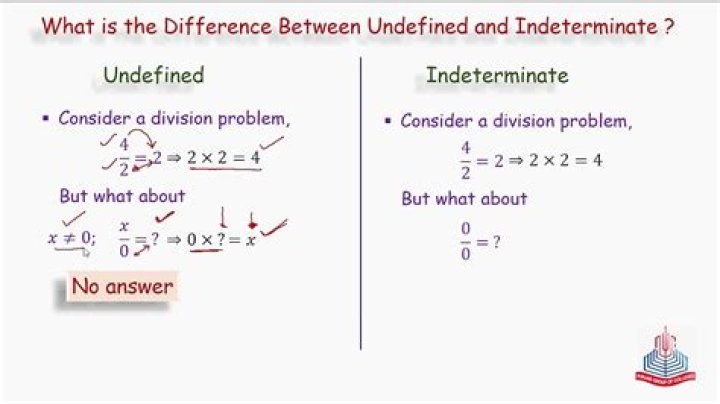
I want to know the difference between these two terms. My prof told me they are different.
$\endgroup$ 43 Answers
$\begingroup$These statements are about limits. When your prof says that $\infty + \infty$ is undefined, what he means is this: If $\lim_{x\to a} f(x) = \infty$ and $\lim_{x\to a} g(x) = \infty$, then $\lim_{x\to a} (f(x) + g(x))$ does not exist (that is, is undefined). In this case, we can be a little more precise and say $\lim_{x\to a} (f(x) + g(x))=\infty$. The very fast and loose way to write this statement is: $\infty + \infty = \infty$. But again, this is a statement about limits, not about arithmetic with $\infty$, which is after all not a number.
Suppose now that $\lim_{x\to a} f(x) = \infty$ and $\lim_{x\to a} g(x) = \infty$. What can you say about $\lim_{x\to a} (f(x) - g(x))$? You might guess the limit must be zero. It turns out the answer is nothing. Consider each of the cases (let $a=\infty$):
- If $f(x) = x^2$ and $g(x) = x$, then the limit is $\infty$.
- If $f(x) = x$ and $g(x) = x^2$, then the limit is $-\infty$.
- If $f(x) = x^2$ and $g(x) = x^2$, then the limit is $0$.
- If $f(x) = x+1$ and $g(x) = x$, then the limit is $1$. You can see how this case can be modified to make the limit any real number.
- If $f(x) = x + \sin x$ and $g(x) = x$, then $\lim_{x\to\infty}(f(x)-g(x))$ does not exist, nor is it even infinite.
So although we have a shorthand statement “$\infty + \infty = \infty$”, there's no analogous shorthand statement for “$\infty - \infty = \Box$.” This is what it means for a limit to be in indeterminate form—there's no limit theorem that allows us to evaluate it in its current form.
But as you can see in the examples above, indeterminate is not the same thing as undefined. A limit in indeterminate form could be finite, infinite, or neither. It also doesn't mean the limit is unknown or unknowable. It just means we have to work a bit before we can find if the limit exists and what it might be.
$\endgroup$ 2 $\begingroup$I thik that an example can be useful.
Consider a function $F(x)=\dfrac{f(x)}{g(x)}$. If there is some $x_i$such that $g(x_i)=0$ the the function $F(x)$ is undefined for such $x_i$ because we can not divide by $0$.
If we consider the limit: $$ \lim_{x\rightarrow x_i}F(x)=\lim_{x\rightarrow x_i}\dfrac{f(x)}{g(x)} $$ than this expression is defined, i.e. it has a well defined meaning, but it is different from $F(x_i)$ that does not exists, and can be determined or undetermined, depending on the behavior of the two functions $f(x)$ and $g(x)$ at $x_i$. If $f(x_i) \ne 0$ then the limit is defined and determined (it is $\infty$) but if $f(x_i)=0$ than we say that it is undetermined, but note that that does not means that we cannot calculate its value.
$\endgroup$ $\begingroup$An "operation" is an indeterminate if it has no meaning and is undefined if its its value is not known.
$\endgroup$ 7