The derivation of negation of conditional statement is equivalent to and statement
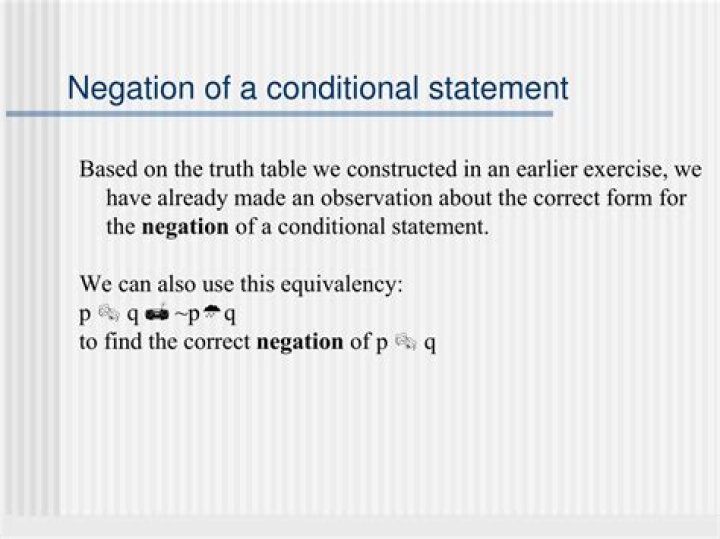
Given P and Q are two statement and $\neg P$ is the negation of P, I want to show that
$\neg(P → Q) \implies (P\cap \neg Q)$
I can show the other way,
$(P\cap \neg Q)\implies \neg(P → Q)$
by assuming the condition and negation of the conclusion. Yet I do not know how to prove this equivalence from conditional statement to and statement since assuming the condition $\neg(P → Q)$ does not give any truth value for $P$ or $Q$.
$\endgroup$ 12 Answers
$\begingroup$Use indirect proofs. Reduction to Absurdity and Proof of Negation.
Assume $\neg P$ to derive $P\to Q$; a contradiction! Therefore deduce $P$.
Assume $Q$ to derive $P\to Q$; a contradiction! Therefore deducing $\neg Q$.
$\endgroup$ $\begingroup$... assuming the condition $\neg(P → Q)$ does not give any truth value for $P$ or $Q$.
Not true. Since the only way for a conditional to be false is for the antecedent to eb true and the consequent to be false, we should be able to infer both $P$ and $\neg Q$ from $\neg (P \to Q)$
Here's how: