Taylor series of $\csc(x)$
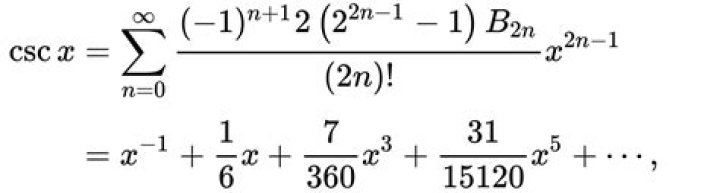
How can I compute the Taylor series of $\csc(x):=\frac{1}{\sin(x)}$ at $0$? When I google this I can see that indeed this series can be computed, the first term being $1/x$ but how can this be if $\sin(x)$ vanishes at $x=0$?
$\endgroup$ 21 Answer
$\begingroup$What you found in Wikipedia can't be a Taylor series. In fact there's not such thing as the Taylor series of $\csc(x)$ at $x=0$ since this function is not defined at $x=0$, much less the derivatives of any order.
You probably found the Laurent series(*). Since$$g(x)=x \csc x=\frac x{\sin x}$$is continuous and differentiable at $x=0$ if we define $g(0)=1$, and it's Taylor series can be found, say$$g(x)=a_0+a_1x+a_2x^2+\cdots$$at least at some interval containing $x=0$, then$$\csc x= \frac{g(x)}x=\frac{a_0}x+a_1+a_2 x+a_3 x^2+\cdots,$$which gives the aforementioned Laurent series.
(*) The Laurent series of a function at $x=a$ is a generalization of the Taylor series for functions $f(x)$ with a pole at $x=a$, that is, functions that go to infinity at $x=a$ but such that $(x-a)^k f(x)$ has a removable discontinuity at $x=a$. If $k$ is the least integer such that this is true, then the Laurent series has the form$$f(x)=\frac{b_{-k}}{(x-a)^k}+\cdots+\frac{b_{-2}}{(x-a)^2}+\frac{b_{-1}}{x-a}+b_0+b_1(x-a)+b_2(x-a)^2+\cdots.$$
$\endgroup$ 2