Tangent to $e^x$
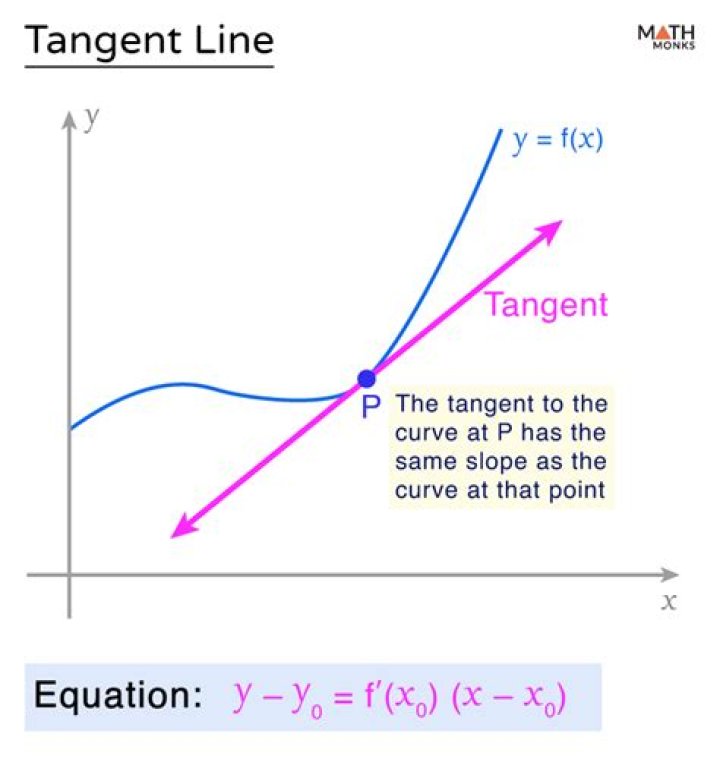
I have been asked to find the tangent to $y=e^x$ that passes through origin. This is what i came up with.
Tangent $f(x)=e^x(x-a)+f(a)$, where a is zero, I therefore conclude with $e^xx$ to be the tangent line, however the book says the answer is ex. By looking at the formula this makes more sense because it is a straight line. But I have learned that the derivative of $e^x$ is $e^x$. Could someone explain what I am missing?
$\endgroup$ 55 Answers
$\begingroup$The tangent to the graph at $x=a$ has the equation $y=e^a+e^a(x-a)=e^a(x-a+1)$. You want this to pass through the origin, so $(x,y)=(0,0)$ should fit the equation, i.e., $0=e^a(-a+1)$, with the solution $a=1$. The final equation is $y=ex$, as the problem stated.
$\endgroup$ $\begingroup$The formula for a line is given by: $$l(x) = ax + b.$$ Here $a$ is the slope of the line. Since $y=e^x$ you have $y^\prime=e^x$ and hence the slope of the tangent line at (the currently unknown) $x=\tilde{x}$ is $a=e^\tilde{x}$. So: $$l(x) = e^\tilde{x}x+b.$$ You know two points through which your line passes: $(0,0)$ and $(\tilde{x},e^\tilde{x})$. The first point gives $b=0$. The second one gives $\tilde{x}=1$. Concluding: $$l(x)=ex,$$ as stated in the problem.
$\endgroup$ $\begingroup$To find the tangent to $ y = e^x$ that passes through the origin ($x=0$, $y=0$) we are looking for an equation of the form $y = m \cdot x + c$ so the first step is to find the equation for the tangent to $y = e^x$ at $x = a$
We know $m = \dfrac{dy}{dx}$ at $x = a$ therefore $m = e^a$ and we can find $c$
Since $m \cdot x + c = e^a \cdot x + c = e^a$ when $x = a$, $c = e^a-a \cdot e^a=(1-a)\cdot e^a$
Our equation for the tangent to $y = e^x$ when $x = a$ is:
$y = m\cdot x + c = e^a \cdot x + (1 -a)\cdot e^a = e^a\cdot (x + 1 - a)$
Finally we need to solve this for $a$ knowing when $x = 0$, $y = 0$
$0 = e^a \cdot (1 -a) \Rightarrow a=1$ or $e^a = 0 \Rightarrow a = - \infty$
since $-\infty$ is not a number but a limit the only solution is
$y = e^1\cdot (x+1-1) = e \cdot x$
$\endgroup$ $\begingroup$Given: $y=e^x$ So, $\frac{dy}{dx}=e^x$
So slope of tangent at $(0,0)= e^0=1$
Equation of tangent passing through $(0,0)$ and having slope $1$ is:
$(y-0)= 1\cdot(x-0)$ $\Rightarrow y=x$ $\Rightarrow x=e^x$
Is this the answer?
EDITED: I think I get our mistake now. We are finding the equation of tangent AT origin when we are required to find the equation of the tangent PASSING THROUGH origin.
So, we'll find the equation of tangent at a point $(a,a)$ that passes through $(0,0)$, and hence find the value of this $a$ and the equation, as has been done by the user here. :)
$\endgroup$ 4 $\begingroup$I thought you might find it useful if someone told you what your error was (actually, you have two errors - the equation you obtained should be $y=e^0x\Rightarrow y=x$ not $y=e^xx$). This answer is a complementary to my comments below Diya's answer.
You have first found the gradient of the tangent to $y=e^x$, and then translated this tangent so that it goes through the origin. So you tweaked the $y$-value! The $y$-value should be $y=e^0=1\neq 0$. This translation means that your lines do not actually meet (so $y=x$ cannot be a tangent)! This is shown in the following image.
This is why when you are given a "find the tangent to the curve" question you are usually given just and $x$-value (sometimes just a $y$-value)$^{\dagger}$. If you get both then the point will be on the line (unless the author has made a mistake - which, if you will excuse my cynicism, is why just giving the $x$-value is more common!).
$^{\dagger}$ For example, "find the tangent to the curve $y=x^4+2$ when $x=0$", or "find the tangent to the curve $y=x^3$ then $y=8$".
$\endgroup$ 2