Sum of positive definite matrices still positive definite?
I have two matrices, which are square, symmetric, and positive definite. I would like to prove that the sum of the two matrices still have the same properties, that is square, symmetric, and positive definite. The first two properties are obvious, what about the positive definite property. Any clue to the proof? Thank you.
$\endgroup$ 13 Answers
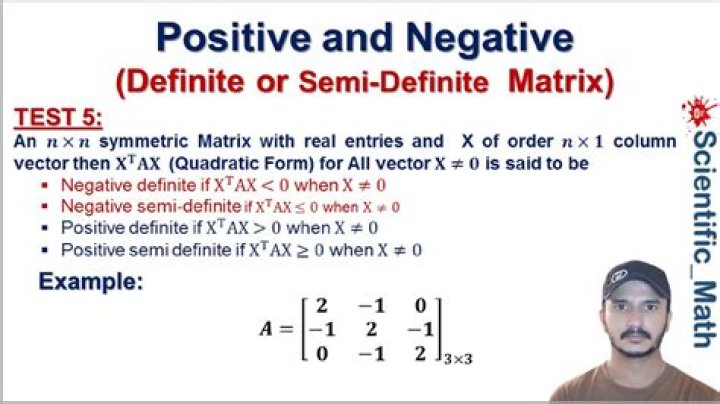
$\begingroup$A real matrix $M$ is positive-definite if and only if it is symmetric and $u^TMu > 0$ for all nonzero vectors $u$.
Now if $A$ and $B$ are positive-definite, $u^T(A+B)u = \ldots?$
$\endgroup$ 6 $\begingroup$This is an more detailed answer.
Now let $ A $ and $B$ be positive definite matrices, that is for all $ h \; \in \mathbb{R} ^{n}$ we must have $ h^{T}Ah > 0 $ and $ h^{T}Bh > 0 $.
From properties of real numbers
$0 < h^{T}Bh + h^{T}Ah $
Now from the distributive laws of matrix multiplication we must have
$0< h^{T}Bh + h^{T}Ah =h^{T} (B + A)h $
This implies that $0<h^{T} (B + A)h $ meaning $ B+A \succ 0$.
That is $ B+A $ is positive definite.
$\endgroup$ 0 $\begingroup$A+B, or B+A, is positive definite if both A and B are positive definite. Suppose A is a m1*n1 matrix and B is a m2*n2 matrix. Because you can sum them up, m1=m2, n1=n2. Since then, as you add up these two matrices, the properties of leading principal minors will not change from the old. Since then, A+B is positive definite. Good luck!
$\endgroup$