Subtracting two integrals, each a product of two functions
I hope this isn't too rudimentary, but after digging and thinking through it, I can't be sure I can do the following:
$\int_{a}^{b} f(x)g(x) dx - \int_{a}^{b} f(.5 x)g(x) dx$ = $\int_{a}^{b} \left[f(x)-f(.5x) \right] g(x) dx$
Does this transformation hold true? I know I can do it in the discretized form, but wasn't sure about in the continuous.
Thank you!
$\endgroup$ 11 Answer
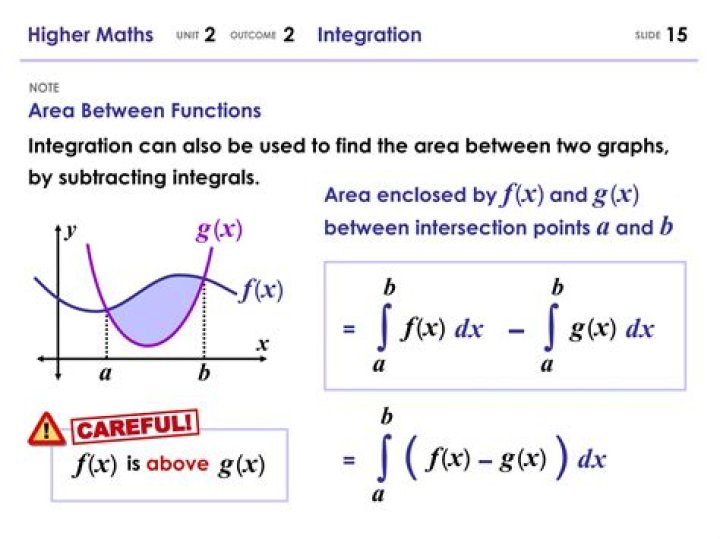
$\begingroup$Yes. Integration is linear: $$\int_a^b f(x)\, dx + \int_a^b g(x)\, dx = \int_a^b f(x)+g(x)\,dx.$$ You can see this by "discretizing" the integrals as Riemann sums, or, more intuitively, by visualizing areas under curves: the areas under $f$ and $g$ "stack" and add.
Applying linearity to your problem. $$\int_a^b f(x)g(x)\, dx - \int_a^b f(x/2)g(x)\,dx = \int_a^b \left[f(x)g(x)-f(x/2)g(x)\right]\,dx$$ after which you can simply factor out the $g(x)$ inside: $$\int_a^b \left[f(x)g(x)-f(x/2)g(x)\right]\,dx = \int_a^b \left[f(x)-f(x/2)\right]g(x)\,dx.$$
$\endgroup$