"Subset of above not equal to" $ \subsetneqq $ Symbol
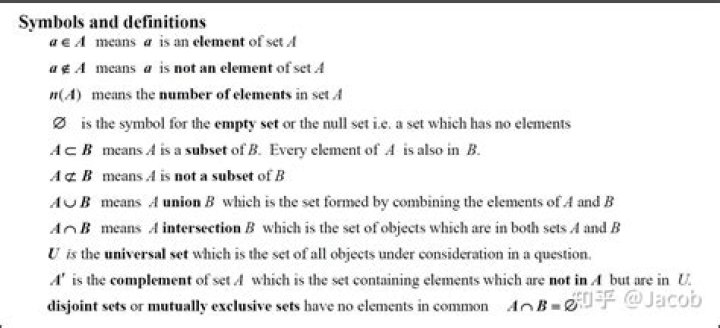
I was reviewing my Algebra diary, and I noticed a symbol that I was not familiar to: $ \subsetneqq $.
After some research on the internet I eventually found it (through UNICODE), and found that the name was "Subset of above not equal to", but I don't understand it.
After some more search, I eventually find something here on stackexchange, but I find some conclusions a bit confusing for me.
If it means "Subset of above not equal to", how can it also mean "Subset properly included in"? Can we say that the symbol $ \subsetneqq $ equals the symbol $ \subset $?
Thanks in advance.
$\endgroup$ 22 Answers
$\begingroup$The symbol $\subset$ can be ambiguous. $A\subset B$ usually allows the possibility that $A=B$, but some authors use it to mean that $A$ is a proper subset of $B$, so that $A\subset B$ implies $A\ne B$. A variety of symbols have been invented to clear up this ambiguity and make explicit whether the $A=B$ possibility is intended:
$$\begin{array}{cl} \text{Symbol} & A=B \text{ allowed?}\\ \subset & \text{probably?} \\ \subseteqq & \text{yes} \\ \subsetneqq & \text{no} \\ \subseteq & \text{yes} \\ \subsetneq & \text{no} \end{array}$$
The construction of the symbols should be clear: $A\subsetneqq B$ means that both $A\subset B$ and $A\ne B$.
The forms $\subseteq$ and $\subsetneq$ should be understood as abbreviations for the symbols $\subseteqq$ and $\subsetneqq$, which are too tall to fit into a line of text.
The Unicode name of $\subsetneqq$ is purely descriptive of what the symbol looks like: It is a “subset of” symbol ($\subset$) above a “not equal” symbol ($\neq$); hence the name is SUBSET OF ABOVE NOT EQUAL. Unicode names can sometimes be a little hard to parse; just yesterday I was puzzled by MUSICAL SYMBOL WITH FINGERNAILS (𝆳).
$\endgroup$ 1 $\begingroup$It means proper inclusion, i.e. $A\subsetneqq B$ if and only if $A\subseteq B$ and $A\neq B$. It is used rather than $\subset$ to emphasise that there is definitely not equality between the two sets.
$\endgroup$ 4