Statement of Parseval's theorem for Fourier Transform
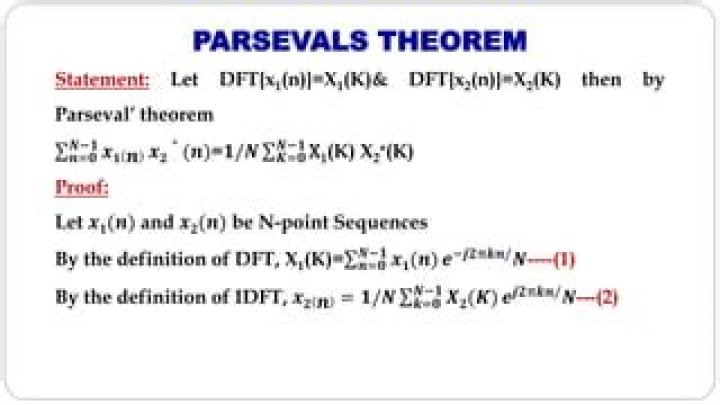
the following is the statement of Parseval's theorem from Wikipedia,
Suppose that $A(x)$ and $B(x)$ are two square integrable (with respect to the Lebesgue measure), complex-valued functions on $\mathbb{R}$ of period $2\pi$ with Fourier series$$A(x) = \sum_{n=-\infty}^{\infty} a_n e^{inx} $$and$$B(x) = \sum_{n=-\infty}^{\infty} b_n e^{inx} $$respectively. Then$$\sum_{n=-\infty}^{\infty}a_n \overline{b_n} = \frac{1}{2\pi} \int_{-\pi}^{\pi}A(x) \overline{B(x)} dx$$where $i$ is the imaginary unit and horizontal bars indicate complex conjugation.
I would like to know if the above statement still hold when $A(x) = \sum_{n=-\infty}^{\infty} a_n e^{-inx} $ and $B(x) = \sum_{n=-\infty}^{\infty} b_n e^{-inx} $. The only changes is the negative in exponential.
$\endgroup$ 11 Answer
$\begingroup$Yes: a possibility is to work with the functions $\widetilde{A}\colon x\mapsto A\left(-x\right)$ and $\widetilde{B}\colon x\mapsto B\left(-x\right)$ then do the substitution $y=-x$ in the integral.
$\endgroup$