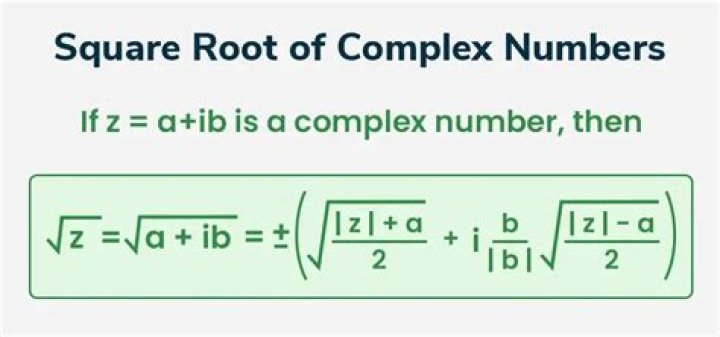
Square root of complex number.
The complex number $z$ is defined by $z=\frac{9\sqrt3+9i}{\sqrt{3}-i}$. Find the two square roots of $z$, giving your answers in the form $re^{i\theta}$, where $r>0$ and $-\pi <\theta\leq\pi$
I got the $z=9e^{\frac{\pi}{3}i}$. So I square root it, it becomes $3e^{\frac{\pi}{6}i}$. But the given answer is $3e^{-\frac{5}{6}\pi i}$. Why?
$\endgroup$ 22 Answers
$\begingroup$Notice, $$z=\frac{9\sqrt 3+9i}{\sqrt 3-i}$$ $$=\frac{9(\sqrt 3+i)(\sqrt 3+i)}{(\sqrt 3-i)(\sqrt 3+i)}$$ $$=\frac{9(\sqrt 3+i)^2}{3-i^2}=\frac{9(2+2i\sqrt 3)}{3+1}$$$$=9\left(\frac{1}{2}+i\frac{\sqrt 3}{2}\right)=9\left(\cos\frac{\pi}{3}+i\sin \frac{\pi}{3}\right)=9e^{i\pi/3}$$ hence, the square roots of $z$ are found as follows $$z^{1/2}=\sqrt{9\left(\cos\frac{\pi}{3}+i\sin \frac{\pi}{3}\right)}$$ $$=3\left(\cos\left(2k\pi+\frac{\pi}{3}\right)+i\sin \left(2k\pi+\frac{\pi}{3}\right)\right)^{1/2}$$$$=3\left(\cos\left(\frac{6k\pi+\pi}{6}\right)+i\sin \left(\frac{6k\pi+\pi}{6}\right)\right)$$ where, $k=0, 1$
Setting $k=0$, we get first square root $$z^{1/2}=3\left(\cos\left(\frac{6(0)\pi+\pi}{6}\right)+i\sin \left(\frac{6(0)\pi+\pi}{6}\right)\right)=3\left(\cos\left(\frac{\pi}{6}\right)+i\sin \left(\frac{\pi}{6}\right)\right)=\color{red}{e^{\frac{\pi}{6}i}}$$ Now, setting $k=1$, we get second square root $$z^{1/2}=3\left(\cos\left(\frac{6(1)\pi+\pi}{6}\right)+i\sin \left(\frac{6(1)\pi+\pi}{6}\right)\right)$$ $$=3\left(-\cos\left(\frac{\pi}{6}\right)-i\sin \left(\frac{\pi}{6}\right)\right)$$ $$=3\left(\cos\left(-\frac{5\pi}{6}\right)+i\sin \left(-\frac{5\pi}{6}\right)\right)=\color{red}{e^{\frac{-5\pi}{6}i}}$$
$\endgroup$ $\begingroup$The exponential of an imaginary number is a periodic function with period $2\pi$, so your number $z$ can be represented as $z=9e^{i(\frac{\pi}{3}+2k\pi)}$, and the square roots are: $$ z^{\frac{1}{2}}=3e^{\frac{1}{2}i(\frac{\pi}{3}+2k\pi)}=3e^{i(\frac{\pi}{6}+k\pi)} $$ that, for $k=0$ is $3e^{i\frac{\pi}{6}}$ and for $k=1$ is $3e^{i\frac{7\pi}{6}}=3e^{i\frac{-5\pi}{6}}$ (that you can also find for $k=-1$).
$\endgroup$