Singular solution of differential equation
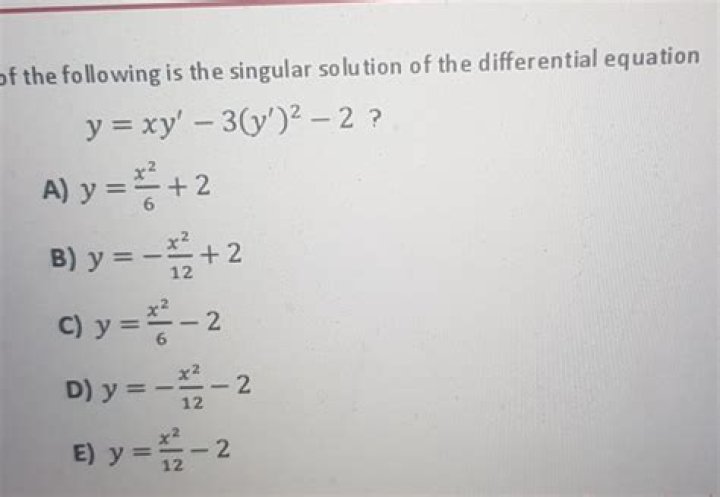
I have seen the standard examples on this topic. I am a little confused about it. If we are given any random differential equation, how do we identify that it would have singular solution as well? Is it possible that in my method of solving ,I may not obtain the singular solution. I mean the examples I saw had DE in terms of $x,y$ and $\frac{dy}{dx}$ . If I somehow manage to solve by Linear DE form, I won't obtain the singular solutions.
Also can someone give me examples of DE where multiple singular curves are obtained?
1 Answer
$\begingroup$Question I : "If we are given any random differential equation, how do we identify that it would have singular solution as well ?"
Answer: For this you have to check the uniqueness of solution (click here for the theorem) of the given differential solution. If there is unique solution then, the given differential equation does not have any singular solution. If your given differential equation is of Clairaut's form , i.e., of the form $$y=px+f(p)\qquad \text{where $p=\frac{dy}{dx}$}$$ then you make a conclusion that this differential equation has singular solution (for example click here).
Question II : "If I somehow manage to solve by Linear DE form, I won't obtain the singular solutions."
Answer: Yes, linear differential equations does not have any singular solutions. For explanation click here.
Question III : "$~~\cdots$ give me examples of DE where multiple singular curves are obtained ?"
Answer: Yes, there may exists more than one singular solutions. For counter example click here.
$\endgroup$