simple geometry question- equation of cylinder
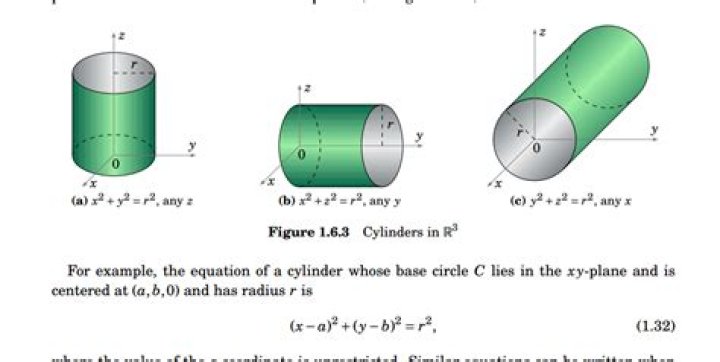
A cylinder is $(x-a)^2+(y-a)^2=r^2$ with axis at $z$. I don't see where the '$z$' is in the equation. The book (calc 3) I'm using mentions the equation works for any $z$, but I don't see where the $z$ output is in the equation
Here is the excerpt from the book, the only part referencing to the basic equation of the cylinder as I've read 1-2 chapters beyond this point (it is a 4 chapter vector calc text)
7 Answers
$\begingroup$If you really want an equation with z that support any cylinder position or rotation you can find it on another thread here :
$$(y−z)^2+(z−x)^2+(x−y)^2=3R^2$$
The link :Formula for cylinder
I searched it for while so I leave it here to help any other person searching for it !
$\endgroup$ 1 $\begingroup$The equation of an object is a way of telling whether a point is part of an object -- if you substitute the coordinates of the point into the equation and the equation is true, then the point is on the object; if the equation is not true for that point, then the point is not on the object. There is no $z$ because the z-coordinate is not part of the decision of whether a point is on the cylinder.
The fact that there is no z tells you that all points where the x- and y-coordinates satisfy the equation are part of the cylinder, regardless of the value of z. For example, if the equation is $(x-1)^2 + (y+2)^2 = 4$, then one of the points on the cylinder is (1,0,0), but so is (1,0,1) and (1,0,-1) and (1,0,5) and (1,0, -789) and so on. This means that the cylinder goes on forever both up and down.
$\endgroup$ $\begingroup$Another way to think about this is the equations of the axes themselves. For instance, take the z-axis. All points on it have x=0 and y=0. Clearly it is a line with any z-allowed.
You could write the equation of the axis as $x^2+y^2=0$, because in the reals the only solution to this equation is $x=0$ and $y=0$.
This shows you that the z-axis is like an infinitely thin cylinder (with a point cross section / 0 radius). If you allowed a positive number $a^2$ on the right side, $x^2+y^2=a^2$ all you do is increase the radius / cross-sectional area. However, you still have an equation satisfied for any value of z, just like the z-axis itself.
$\endgroup$ $\begingroup$This is the implicit equation of a cylinder: a point $(x,y,z)$ lies on the cylinder if it satisfies the equation. The important thing here is in fact that $z$ does not occur in the equation. Which means that if some point $(x,y,z)$ lies on the cylinder, then another point $(x,y,z')$ which differs from the first only by a change in its $z$ coordinate will satisfy the same equation and therefore lie on the same cylinder. That's where the $z$ axis comes into play.
An alternative to these implicit equation sowuld be parametric equations, which describe how you compute the coordinates of points using three parameters, e.g. $(r\sin\varphi+a,r\cos\varphi+b,z)$ for $\varphi\in[0,2\pi),z\in\mathbb R$.
$\endgroup$ $\begingroup$People tend to over-complicate when there is already intuition for this concept. Take for example a 2D graph, and you want to plot $x = 2$. You will draw the vertical line that passes at $x = 2$, since you learned in school that it is implicitly true for all values of $y$. Note that you do not see the $y$ in this equation. Similarly, when dealing with 3D and you want to plot something like $x^2 + y^2 = 1$, you assume that this holds for all $z$ values, even though you do not see it in the equation.
$\endgroup$ $\begingroup$The equation $(x-a)^2 + (y-b)^2 = r^2$ describes a circle on the x/y plane; of radius $r$ and centre $(a, b)$. It's solutions include all the combinations of $x$ and $y$ that make up a two dimensional circle, and no other points.
Now for 3d space we have a z-axis too, For which values of $z$ is the equation true?
Since $z$ is not mention in the equation, its true for all $z$, positive, zero or negative.
The equation therefore describes an infinite cylinder.
$\endgroup$ $\begingroup$An equation for a smoothed cylinder can be :
$$ x^2+y^2+z^{2n} = 1 $$
with $n\in\mathbb{N}$, $n\neq0$.
The greater the $n$ the smoother the top and bottom edges resulting from the "cut" of the infinite cylinder.
See for example
$\endgroup$