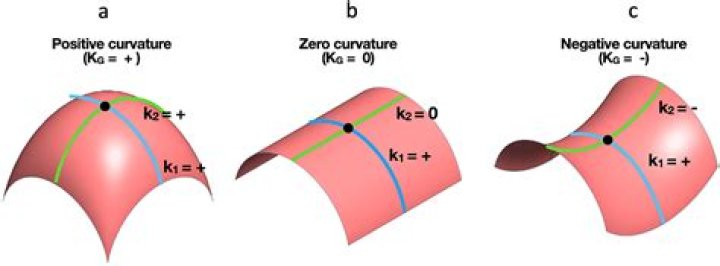
showing zero curvature implies a line
How can I show that a given (not necessarily unit-speed) parametrization $\gamma(t)$ of a curve in $\mathbb{R}^3$ which exhibits zero curvature is a line ? What I know is that zero curvature means that $$ \kappa(t) = \frac{\|\langle\dot\gamma(t),\dot\gamma(t)\rangle \ddot\gamma(t) - \langle\dot \gamma(t),\ddot \gamma(t)\rangle\dot \gamma(t)\|}{\|\dot \gamma(t)\|^4} = 0 $$ from which I can deduce that $$ \langle\dot\gamma(t),\dot\gamma(t)\rangle \ddot\gamma(t) = \langle\dot \gamma(t),\ddot \gamma(t)\rangle\dot \gamma(t) $$ that is, $$ \ddot\gamma(t) = \frac{\langle\dot \gamma(t),\ddot \gamma(t)\rangle}{\|\dot\gamma(t)\|^2} \dot \gamma(t) \qquad \text{for all } t\,. $$ Somehow I am blind here - how does this tell me then that $\ddot \gamma(t)$ vanishes identically? For this is what I need to deduce that $\gamma(t)$ is a line ..
Many thanks for your hints!
$\endgroup$ 61 Answer
$\begingroup$$\ddot \gamma(t)$ won't vanish in general, just think of $t\mapsto (t^2, 0,0)$. If you don't want to reparametrize $\gamma$, you will need to show that $\gamma(t) = f(t) v_0$ for some vector $v_0$ and a scalar function $f(t)$. To do this you could for instance argue that the unique solution to $$\dot v(t) = g(t) v(t), \; v(0) = v_0, \qquad \text{where } g(t) := \frac{\langle\dot \gamma(t), \ddot \gamma(t)\rangle}{\Vert \dot \gamma(t)\Vert^2}$$ is given by $v(t) = f(t)v_0$ for some function $f$.
$\endgroup$