showing $\arctan(\frac{2}{3}) = \frac{1}{2} \arctan(\frac{12}{5})$
I'm having problem with showing that: $$\arctan(\frac{2}{3}) = \frac{1}{2} \arctan(\frac{12}{5})$$
I would need some help in the right direction
$\endgroup$4 Answers
$\begingroup$$(3+2i)^2=5+12i$, so $\arctan\frac23+\arctan\frac23=\arctan\frac{12}{5}$.
Alternatively, study this diagram:
From the Article $240,$ Ex$-5$ of Plane Trigonometry(by Loney),
$$\arctan x+\arctan y=\begin{cases} \arctan\frac{x+y}{1-xy} &\mbox{if } xy<1\\ \pi+\arctan\frac{x+y}{1-xy} & \mbox{if } xy>1\end{cases} $$
$$\implies 2\arctan x=\arctan \frac{2x}{1-x^2}\text{ if }x^2<1$$
Here $\displaystyle x=\frac23$
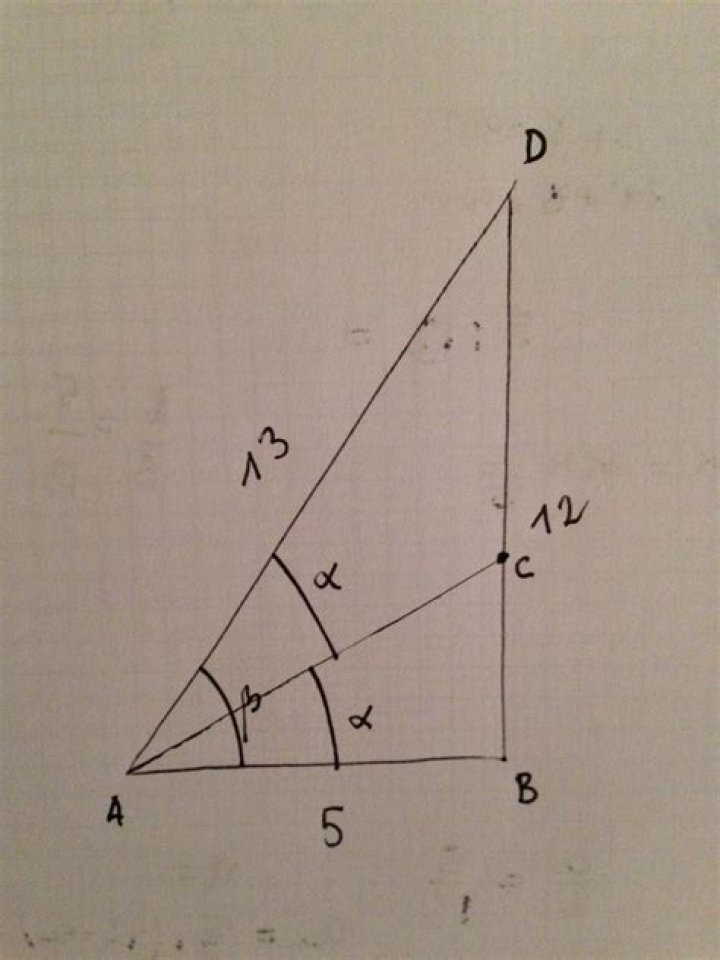
$\endgroup$ 0 $\begingroup$There is a nice geometrical way of showing that. Your statement can be shown with the bisector theorem ()... Check the picture
Sorry but I have quickly drawn it. Now your problem is equivalent to say that $\arctan(\frac{2}{3}) = \alpha$ since $\beta = \arctan(\frac{12}{5})$. For the bisector theorem it is true that $$ \frac{BC}{CD} = \frac{5}{13} $$ now we know that $BC+CD=12$ and solving the two equations we find that $BC=10/3$ that is exactly equivalent saying $$ \arctan(\alpha) = \frac{2}{3} $$ that is exactly what we wanted to demonstrate.
This was fun ;-)
$\endgroup$ $\begingroup$The basic concept of inverse trigonometry is as follows - Arctan is same as tan^-1 with in the specified values.
tan^-1 x + tan ^-1 y = tan ^ -1 (x+ y/1−xy) if xy<1 π+ tan ^ -1 (x+y/1−xy) if xy>1 and x>0 and y>0 -π + tan ^ -1 (x + y/1-xy) if xy>1 and x<0 and y
This concept will solve your proof above by instantly putting the given value of x.
$\endgroup$