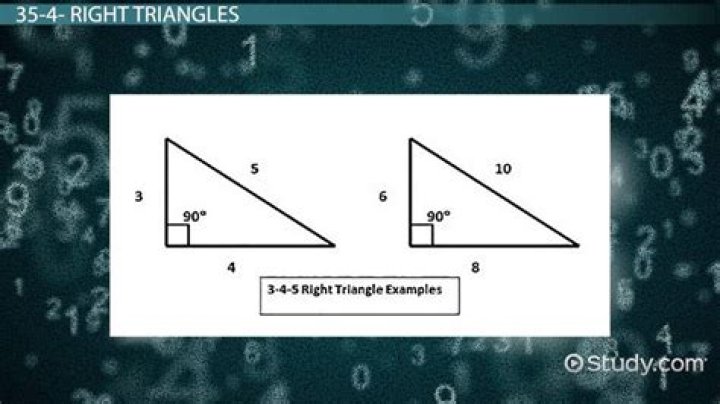
Show, without invoking the Pythagorean theorem, that the $3-4-5$ triangle is right
The ancient Egyptians knew the $3-4-5$ triangle was a right triangle, but they did not possess the Pythagorean theorem or any equivalent theory. Can it be shown that the $3-4-5$ triangle is a right triangle without using the Pythagorean theorem or any ideas related to it?
This problem was shown to me by a fellow peer tutor a while ago. I gave it some thought initially, but then I gave up trying when I realized it might not be doable. What do you think?
$\endgroup$ 73 Answers
$\begingroup$Take a stick length $3$ and another length $4$. Place these at right-angles to each other. Create a stick to measure the diagonal. Demonstrate that this stick plus the $3$-stick is the same length as two $4$-sticks. (You can create a $3$-stick from a $4$-stick by bisecting a $4$-stick, appending, and bisecting again).
$\endgroup$ 3 $\begingroup$This is a proof (without using Pythagoras' theorem) of the following: If a right-angled triangle has a hypotenuse of length 5 and one leg of length 3, the remaining leg is of length 4, i.e. it must be a 3-4-5 triangle.
Given that the sides of a triangle uniquely determine its angles we should conclude from the above that a 3-4-5 triangle has to be right-angled.
Start by drawing a 5-5-6 rectangle with one of the length-5 sides as its base. Extend the base by a line of length 5:
Draw a circle with the three lines of length 5 as radii:
Draw an altitude of the original triangle to the side of length 6. Also, join the top of the triangle to the end of extended line of length 5:
If we call the equal angles in the isosceles 5-5-6 triangle $\theta$ then we can calculate some of the other angles. In particular the angle between the altitude drawn earlier and the base is $\pi/2 - \theta$ and this equals the angle between the line joining the top of the triangle and the extended line.
So the altitude is parallel to the line joining the top to the right extension. Also, by similar triangles, if the altitude has length $x$ then the second line has length $2x$
If we extend the other radius of length 5 to make it a diameter of the circle, we can complete a cyclic quadrilateral with the edges shown and with its diagonals both being diameters of the circle
Ptolemy's theorem says that, for a cyclic quadrilateral, the product of the two diagonal lengths equals the sum of the products of opposite sides. In our case, this means that
$$ 10 \times 10 = 6 \times 6 + 2x \times 2x \Rightarrow 100 = 36 + 4x^2 \Rightarrow 25 = 9 + x^2 $$
which means that $x=4$ and we have not used Pythagoras to find this value.
So we have shown that the `half' of the original triangle defined by the base, the altitude and the length of 3 joining the base to the altitude is a 3-4-5 triangle.
There can only be one 3-4-5 triangle, we cannot have a second one with different angles. So we have shown that a 3-4-5 triangle must be right-angled.
On a Cartesian coordinate plane start with $O=(0,0), A=(2,0), B=(0,1)$. Construct lines parallel to $OA$ through $B$ and parallel to $OB$ through $A$, which intersect at $C=(2,1)$. Draw $OC$ and construct the perpendicular to it through $C$, which intersects line $OB$ at $D$. Triangle $OCD$ is similar to triangle $OBC$ so $|BD|/|BC|=|BC|/|OB|=2$, then $|BD|=4, |OD|=1+4=5$.
Extend $DC$ through $C$ to point $E$ such that $EC$ is congruent to $CD$. Extend $BC$ through $C$ to point $F$ such that $CF$ is congruent to $BC$. Draw $EF$ which intersects line $OA$ at $G$. Vertical angles $BCD, FCE$ are congruent, therefore triangles $BCD, FCE$ are also congruent by SAS. So $|FE|=|BD|=4$ and $\angle CFE$ is a right angle like $\angle CBD$. The latter fact makes $FG$ parallel to $BO$ and we have by earlier construction $BE$ parallel to $OA$. Quadrilateral $OACB$ is then a parallelogram with opposite sides congruent, thus
$|OG|=|BF|=|BC|+|CF|=2+2=4$
$|GF|=|OA|=1, |GE|=|FE|-|GF|=4-1=3$
Now draw the $OE$ to complete triangle $OEF$. $\angle OCE$ is supplementary to $\angle OCD$ which is a right angle, so these angles are congruent making triangles $OCD, OCE$ congruent by SAS. Then $OE$ is congruent to the corresponding side $OD$ and the hypoteneuse $OE$ of right triangle $OEG$ with legs measuring $3$ and $4$ units satisfies $|OF|=|OD|=5$. QED.
$\endgroup$